
TL;DR:
- ESG principles are critical for Australian facility cleaning, influencing regulations, procurement, and building ratings. Integrating ESG into daily operations improves efficiency, staff retention, indoor air quality, and competitive advantage. Verifying certifications such as GECA, ISO 14001, and TGA ensures compliance with upcoming 2026 standards and supports responsible cleaning practices.
ESG — environmental, social, and governance — is often dismissed as corporate jargon or a compliance burden reserved for large listed companies. The reality is quite different, and if you manage a commercial facility in Australia, the role of ESG in cleaning services directly affects your procurement decisions, your building's green rating, and your regulatory obligations right now. The eco-label certified cleaning chemicals market is growing rapidly, driven by ESG requirements that are reshaping what cleaning providers must offer and what you should demand.
Table of Contents
- Understanding ESG and its role in cleaning services
- Regulatory landscape and standards shaping green cleaning in Australia
- Practical benefits of integrating ESG in daily cleaning operations
- Choosing compliant and certified eco-friendly cleaning providers
- Future trends and innovations in sustainable cleaning
- Rethinking ESG in cleaning: beyond compliance to core business advantage
- How Just About Cleaning helps you meet ESG goals
- Frequently asked questions
Key Takeaways
| Point | Details |
|---|---|
| ESG framework explained | Environmental, social, and governance principles make cleaning services sustainable and compliant. |
| Regulatory compliance | Stricter 2026 Australian standards require VOC limits and certifications like GECA for cleaning providers. |
| Operational benefits | Embedding ESG improves efficiency, worker wellbeing, and customer trust beyond compliance. |
| Provider verification | Ask for certifications and safety data to confirm cleaning suppliers meet ESG requirements. |
| Future trends | Innovations like enzymatic cleaners and IoT tracking enhance sustainable cleaning performance. |
Understanding ESG and its role in cleaning services
ESG is not a single regulation. It is a framework that groups sustainability responsibilities into three pillars, each with direct implications for how cleaning is delivered in commercial facilities.
ESG organises sustainability efforts into environmental, social, and governance categories that help cleaning providers meet regulatory and customer demands. For facility managers, this means your cleaning contractor's performance across all three pillars can affect your building's compliance status, your staff's wellbeing, and your organisation's reporting obligations.
Here is what each pillar means in practice for cleaning services:
- Environmental: Use of low-VOC (volatile organic compound) cleaning chemicals, biodegradable formulas, reduced packaging waste, and energy-efficient equipment. This also covers water consumption and responsible chemical disposal.
- Social: Fair wages, safe working conditions, and adequate training for cleaning staff. The social pillar also includes transparency about workforce practices, which matters when you are selecting providers for healthcare or childcare environments.
- Governance: Documented procedures, third-party certifications, audit trails, and clear accountability structures. A provider with strong governance makes your own ESG reporting far easier.
Understanding the cleaning services environmental impact of each decision helps facility managers move from reactive compliance to proactive planning. When ESG is embedded in your cleaning contract, you gain a structured way to track, report, and improve performance across all three pillars without managing it from scratch yourself.
Regulatory landscape and standards shaping green cleaning in Australia
With ESG defined, it is worth examining exactly which regulations are now driving change for Australian cleaning services in 2026.
The 2026 sustainability standards affecting Australian businesses include stricter NSW EPA VOC limits and Green Star certification requirements that directly impact cleaning product selection and facility management decisions. These are not future considerations. They are active obligations.
Key regulatory developments you need to know:
- NSW EPA VOC Regulation (from July 2026): Cleaning products used in New South Wales must comply with updated volatile organic compound limits. Products that exceed these thresholds cannot be legally used in commercial cleaning contracts.
- Green Star certification minimums: Office buildings valued above $15 million are now expected to achieve at minimum a 4 Star Green Star rating. Cleaning practices, including chemical selection and waste management, contribute to this rating.
- Environmentally Sustainable Procurement policy: Suppliers must submit environmental sustainability plans and report measurable metrics, which directly affects cleaning service contracts tied to government or large corporate clients.
- Safe Work Australia standards: Worker safety requirements under the social pillar continue to tighten, with documentation and training records now expected as part of ESG audits.
| Regulation | Scope | Key requirement | Timeline |
|---|---|---|---|
| NSW EPA VOC Regulation | NSW commercial cleaning | Low-VOC compliant products only | From July 2026 |
| Green Star 4 Star minimum | Office buildings over $15M | Cleaning contributes to certification score | Active 2026 |
| Environmentally Sustainable Procurement | Government-linked suppliers | Submit environmental sustainability plans | Ongoing from 2026 |
| Safe Work Australia standards | All cleaning providers | Documented safety and training records | Ongoing |
Staying across cleaning compliance in Australia is now non-negotiable for facility managers who want to avoid penalties and maintain building ratings. The good news is that a well-chosen cleaning provider can handle most of this for you.
Practical benefits of integrating ESG in daily cleaning operations
After examining regulations, the natural question is: does ESG actually improve anything beyond avoiding fines? Yes. Consistently and measurably.

Embedding ESG into daily operations turns it from a reporting exercise into a practical business framework that improves efficiency and compliance at the same time. When a cleaning provider structures their work around ESG principles, you see it in outcomes, not just paperwork.
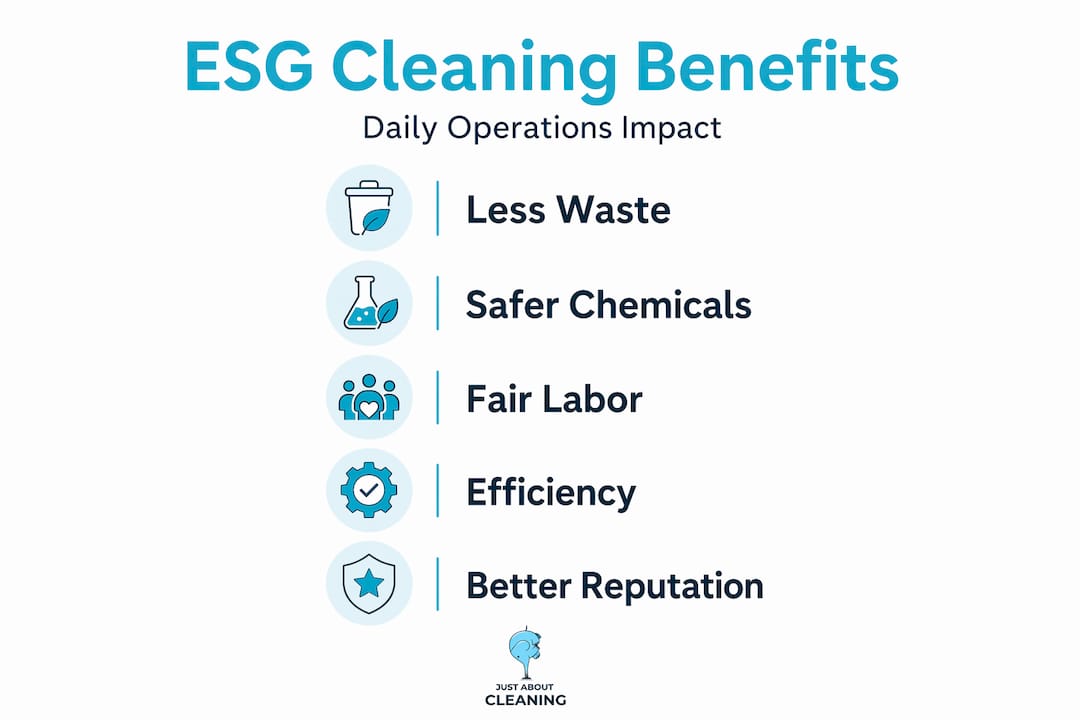
Consider the example of Service By Larsen, a Danish cleaning company that has become a widely cited model in the industry. Their ESG integration into daily operations, including fair working conditions and cradle-to-cradle certified products, has helped them attract values-driven clients who are not choosing on price alone. The same dynamic applies in Australia, where businesses with strong sustainability credentials are increasingly selecting cleaning partners on ESG alignment rather than cost.
Practical benefits you can expect from ESG-integrated cleaning services include:
- Lower staff turnover: Cleaning companies that invest in worker wellbeing and fair wages retain staff longer. For you, this means consistent team members who know your facility, your security protocols, and your specific requirements.
- Reduced chemical costs over time: Concentrated, certified formulas use less product per application, which cuts both chemical spend and waste disposal costs.
- Simpler ESG reporting: When your provider documents everything from product data sheets to training records, your own sustainability reporting becomes far less labour-intensive.
- Healthier indoor environments: Low-VOC products improve air quality for your tenants and staff, which has measurable effects on productivity and sick-day frequency.
Pro Tip: When evaluating cleaning providers, ask specifically how ESG principles are embedded in their scheduling systems, product selection process, and staff training programmes. A provider who can answer this in detail is operating ESG as a genuine framework, not just a marketing claim.
You can explore sustainable cleaning practices that align with these outcomes to better understand what genuine ESG integration looks like from a facility manager's perspective.
Choosing compliant and certified eco-friendly cleaning providers
Having seen ESG benefits, the next practical step is knowing how to verify that a provider actually delivers what they claim.
Requesting Material Safety Data Sheets, TGA registration numbers, and GECA certification from providers is now standard due diligence. Absence of these documents is a strong indicator of non-compliance with Australian 2026 standards.
Here is a step-by-step process for auditing and approving a cleaning provider for ESG compliance:
- Request product documentation upfront. Ask for Material Safety Data Sheets (MSDS) for every cleaning chemical they use. Cross-check these against NSW EPA VOC limits.
- Verify GECA certification. Good Environmental Choice Australia (GECA) is Australia's only member of the Global Ecolabelling Network. If their products carry GECA certification, they meet independently verified environmental standards.
- Check ISO 14001 accreditation. This international standard covers environmental management systems. A provider holding ISO 14001 has a structured approach to measuring and reducing their environmental impact.
- Confirm TGA registration. For cleaning products used in healthcare, childcare, or food-handling environments, Therapeutic Goods Administration (TGA) registration is a legal requirement, not an optional extra.
- Review their environmental sustainability plan. Any provider working on government-linked or large corporate contracts must have this documented. Ask to see it before signing.
| Certification | What it covers | Why it matters for your facility |
|---|---|---|
| GECA | Eco-label for cleaning products | Confirms environmental standards for chemicals used on-site |
| ISO 14001 | Environmental management systems | Shows provider has structured processes to reduce environmental impact |
| TGA registration | Chemical safety for healthcare and food environments | Legal requirement for medical, childcare, and food-service facilities |
| Green Star alignment | Building sustainability rating contribution | Cleaning practices contribute directly to your building's Green Star score |
Pro Tip: Make documentation submission a contractual condition, not a verbal agreement. If a provider cannot supply MSDS sheets, TGA numbers, and GECA certificates before contract signing, do not proceed. Gaps in documentation become your compliance risk, not theirs.
Reviewing eco-friendly cleaning certifications in more detail will help you understand exactly what each accreditation covers and how to use it as a selection criterion.
Future trends and innovations in sustainable cleaning
With provider selection covered, it is worth understanding where the industry is heading, because what becomes standard practice in 2027 is already being adopted by leading providers today.
Innovation in enzymatic cleaners, cold-water activation, and biodegradable inputs is improving sustainability without compromising cleaning performance. These are not experimental technologies. They are entering mainstream commercial use and will soon appear in procurement specifications.
Key trends shaping the future of sustainable cleaning in Australia:
- Enzymatic cleaning products break down organic matter biologically rather than through harsh chemical reactions. They are effective at lower concentrations, which reduces both chemical use and wastewater impact.
- Cold-water activated formulas eliminate the energy cost of heating water for cleaning, which contributes meaningfully to a facility's overall energy footprint.
- Concentrated product formats reduce packaging volume and transport emissions. One litre of concentrate replacing ten litres of ready-to-use product is a straightforward win for both cost and ESG reporting.
- IoT-enabled cleaning management uses sensors and digital scheduling to clean areas based on actual usage data rather than fixed schedules. This reduces unnecessary chemical use and labour hours while generating the kind of documented evidence ESG audits require.
"Eco-label certified cleaning chemicals are transitioning from optional procurement preferences to mandatory components of commercial cleaning contracts, driven by regulatory requirements and ESG commitments across industries."
Staying current with sustainable cleaning innovations gives you a practical edge when renegotiating contracts or setting new procurement criteria for your facility.
Rethinking ESG in cleaning: beyond compliance to core business advantage
Here is the uncomfortable truth most articles on this topic avoid: the majority of facility managers are still treating ESG as a checklist item rather than a genuine operational lens. They ask their cleaning provider for a sustainability certificate at contract renewal, file it, and move on. This approach will not hold up as 2026 requirements tighten, and it misses the most valuable part of the whole framework.
ESG achieves its real value only when integrated into everyday operations rather than treated as a separate reporting or compliance task. This means ESG should be influencing which cleaning products are ordered on a Tuesday, how staff are trained on a Thursday, and how incidents are documented and reviewed on an ongoing basis.
The Service By Larsen example is instructive here. Their experience shows that embedding ESG into operations attracts values-driven customers and creates competitive advantage beyond pricing. In Australia, where ESG-linked procurement criteria are now appearing in tender documents across healthcare, education, and government sectors, this is not a Scandinavian case study. It is your near-term reality.
The practical shift we recommend is this: stop evaluating cleaning providers on price per square metre alone. Start evaluating them on the maturity of their ESG integration. Ask them how their ESG commitment has changed their product sourcing in the last 12 months. Ask how they handle a spill of a non-compliant chemical. Ask what their staff turnover rate is and what they attribute it to. These questions reveal whether ESG is genuinely embedded or simply documented.
For facility managers overseeing healthcare environments in particular, the stakes are even higher. ESG in healthcare cleaning is not just about green credentials. It directly intersects with infection control, staff safety, and patient outcomes. A cleaning provider with weak social governance, such as high staff turnover or inadequate training, poses a real clinical risk, not just a reputational one.
The sustainable cleaning approach that genuinely serves your facility is one where ESG shapes the daily workflow, not just the annual audit.
Pro Tip: In your next provider review, ask each candidate to walk you through one specific change they made to their operations in the past year to improve their ESG performance. Providers with genuine integration will have a clear, specific answer. Those treating ESG as a marketing label will not.
How Just About Cleaning helps you meet ESG goals
Aligning your facility's cleaning operations with ESG principles takes more than good intentions. It requires a provider with the certifications, systems, and trained staff to back every claim with documented evidence.
Just About Cleaning has been delivering ESG-compliant commercial cleaning across Australia for over 15 years. Our services include use of GECA-certified and ISO-aligned eco-friendly products, tailored Supplier Environmental Sustainability Plans, and fully trained onsite crews who embed ESG into every shift, not just reporting periods. We support facility managers with Green Star compliance, NSW EPA VOC requirements, and transparent documentation that makes your own ESG auditing straightforward. Flexible contracts mean you are not locked into arrangements that cannot adapt as standards evolve. If you want a cleaning partner who treats ESG as operational practice rather than paperwork, we are ready to talk.
Frequently asked questions
What does ESG stand for in cleaning services?
ESG in cleaning refers to environmental, social, and governance principles that guide sustainable and responsible cleaning practices in commercial facilities. It covers everything from chemical selection to worker welfare and documented accountability.
How do new Australian regulations affect cleaning services in 2026?
From July 2026, cleaning services must comply with NSW EPA VOC limits, obtain certifications like GECA, and support green building ratings such as Green Star to meet new Australian standards.
Why is ESG integration beneficial beyond compliance?
ESG woven into daily operations improves cleaning efficiency, boosts worker satisfaction, and attracts clients who prioritise responsible business practices, creating a genuine competitive advantage.
What certifications should I look for in an ESG-compliant cleaning provider?
Look for GECA product certification, ISO 14001 environmental management accreditation, and TGA registration for chemicals used in sensitive environments. GECA is Australia's gold standard as the country's only member of the Global Ecolabelling Network.
How can facility managers verify a cleaning company's ESG claims?
Request MSDS sheets, TGA registration numbers, and GECA certificates before signing any contract. Failure to produce these documents signals likely non-compliance with Australian 2026 standards.