
TL;DR:
- Hospitality cleaning is a specialized service focused on food safety, guest hygiene, and regulatory compliance.
- It involves a detailed six-step process of cleaning and sanitising, with strict scheduling based on operation needs.
- Using measurable benchmarks and digital tools ensures ongoing quality and compliance in hospitality venues.
Hospitality cleaning is not simply a more thorough version of regular cleaning. It operates under a completely different set of rules, driven by food safety legislation, guest health obligations, and the reputational stakes that come with running a hotel, restaurant, bar, or café in Australia. A missed step in a commercial kitchen or a poorly sanitised bathroom can trigger a compliance breach, a negative review, or worse, a public health incident. This article clarifies what hospitality cleaning actually is, how the core processes work, what scheduling looks like in practice, and how you can measure whether your cleaning programme is genuinely delivering results.
Table of Contents
- What is hospitality cleaning?
- How hospitality cleaning works: Process and compliance
- Scheduling and maintaining cleaning routines
- Standards, metrics, and best practices
- What most guides miss: Smarter cleaning for better outcomes
- Connect with expert hospitality cleaning solutions
- Frequently asked questions
Key Takeaways
| Point | Details |
|---|---|
| Specialised scope | Hospitality cleaning involves tailored methods and schedules focused on hygiene, compliance, and guest experience. |
| Compliance process | Australian venues must follow FSANZ standards, using a verified multi-step cleaning and sanitising routine. |
| Routine scheduling | Effective scheduling and matrix-driven routines drive both legal compliance and quality outcomes in hospitality venues. |
| Measurable standards | Pass rates, defect scores, and ATP tests provide clear metrics to measure cleaning performance. |
| Best practice shifts | Hybrid cleaning, eco-friendly solutions, and digital audits are emerging as best practices in the hospitality industry. |
What is hospitality cleaning?
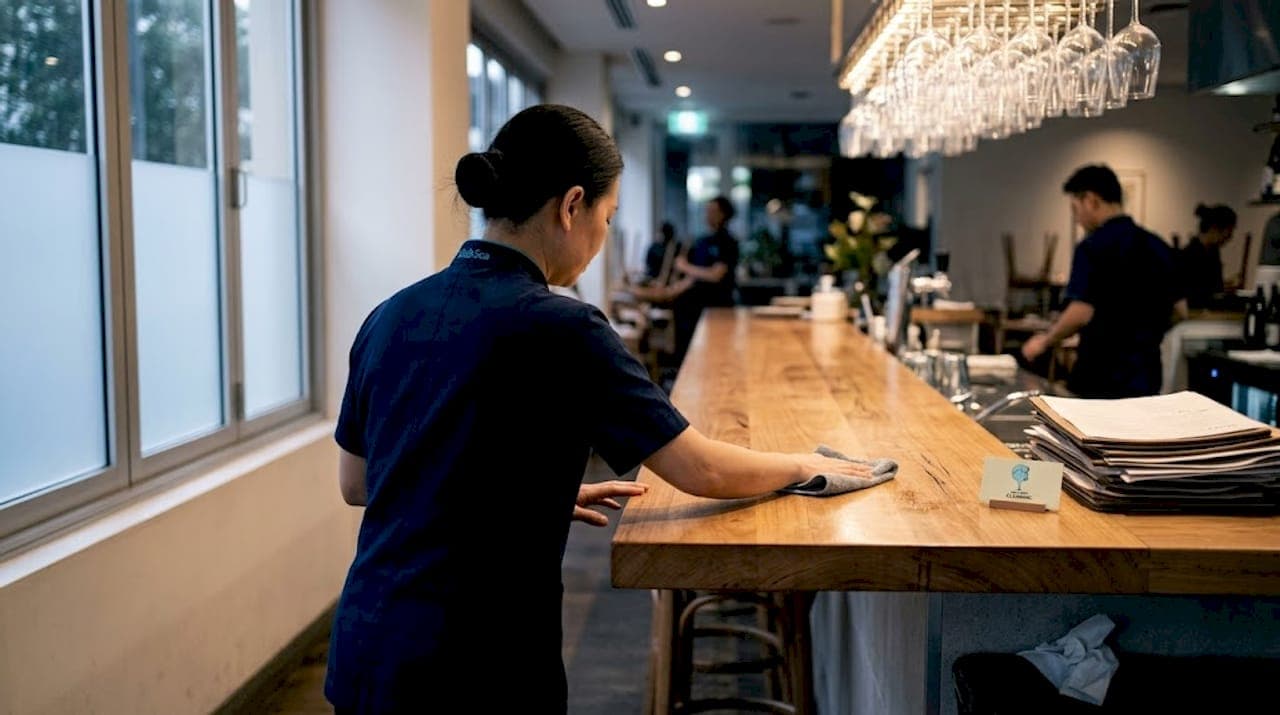
Hospitality cleaning is not a catch-all term for keeping a venue tidy. It refers to specialised professional cleaning services designed specifically for hotels, restaurants, bars, cafés, and clubs. The scope goes well beyond wiping down surfaces. It encompasses food safety compliance, guest-facing hygiene, back-of-house sanitation, and the kind of documented cleaning protocols that hold up under a council or food safety audit.
What sets hospitality cleaning apart from general commercial cleaning is its dual accountability. You are responsible not only to your guests but also to regulators. Food Standards Australia New Zealand (FSANZ) sets binding requirements for how food contact surfaces must be cleaned and sanitised. Local councils conduct inspections. Health departments can issue improvement notices or close venues that fall short.
The scope of hospitality cleaning typically covers:
- Guest rooms and common areas (hotels): linen changes, surface disinfection, bathroom sanitation, and high-touch point cleaning
- Commercial kitchens: benchtops, equipment, exhaust hoods, grease traps, and floor drains
- Front-of-house dining areas: tables, chairs, menus, condiment holders, and service stations
- Bathrooms and amenities: toilets, basins, mirrors, hand dryers, and door handles
- Bar areas: glass washing, bar tops, ice wells, and tap handles
- Storage and cool rooms: shelving, door seals, and temperature-sensitive zones
Scheduling is also tailored differently. A restaurant kitchen requires cleaning between service periods, not just at close. A hotel bathroom needs sanitising between every guest. These rhythms are built around operational reality, not convenience.
Hospitality cleaning must align with your venue's trading hours, peak service periods, and compliance obligations. It is not a one-size-fits-all service.
Understanding the range of cleaning service types available helps venue managers identify exactly what their operation requires, rather than defaulting to a generic contract that leaves compliance gaps.
How hospitality cleaning works: Process and compliance
The distinction between cleaning and sanitising is fundamental, and it is one that many venues blur at their peril. Cleaning removes visible dirt, grease, and food waste using detergent and water. Sanitising destroys microorganisms using heat (at least 77°C for 30 seconds), diluted bleach at 50 to 100 parts per million, or other FSANZ-approved sanitisers. Both steps are mandatory under FSANZ Standard 3.2.2, and neither replaces the other.
A practical six-step process for hospitality venues looks like this:
- Pre-clean: Remove loose food debris and scrape surfaces
- Wash: Apply detergent and warm water to remove grease and residue
- Rinse: Remove detergent residue with clean water
- Sanitise: Apply an approved sanitiser at the correct concentration and contact time
- Final rinse (if required): Some sanitisers require rinsing; check the product label
- Air dry or dry with a clean cloth: Never use a shared cloth across different surfaces
Compliance with cleaning and safety standards is not optional. Venues that cannot demonstrate documented cleaning processes during an audit face improvement notices, fines, or temporary closure.
One practical decision every venue manager faces is whether to clean in-house or outsource to a specialist. Here is a straightforward comparison:
| Factor | In-house cleaning | Outsourced specialist |
|---|---|---|
| Cost control | Higher labour overhead | Predictable contract cost |
| Compliance expertise | Requires ongoing training | Built-in expertise |
| Flexibility | Tied to staff availability | Scheduled around your operations |
| Accountability | Internal only | Documented, auditable |
| Equipment access | Limited | Commercial-grade |
Understanding cleaning compliance requirements helps you make this decision with confidence rather than guesswork.
Pro Tip: Replace paper-based checklists with digital cleaning logs and introduce ATP (adenosine triphosphate) testing in your kitchen. ATP meters measure biological residue on surfaces in seconds, giving you verifiable, audit-ready data that a visual inspection simply cannot provide.
Scheduling and maintaining cleaning routines
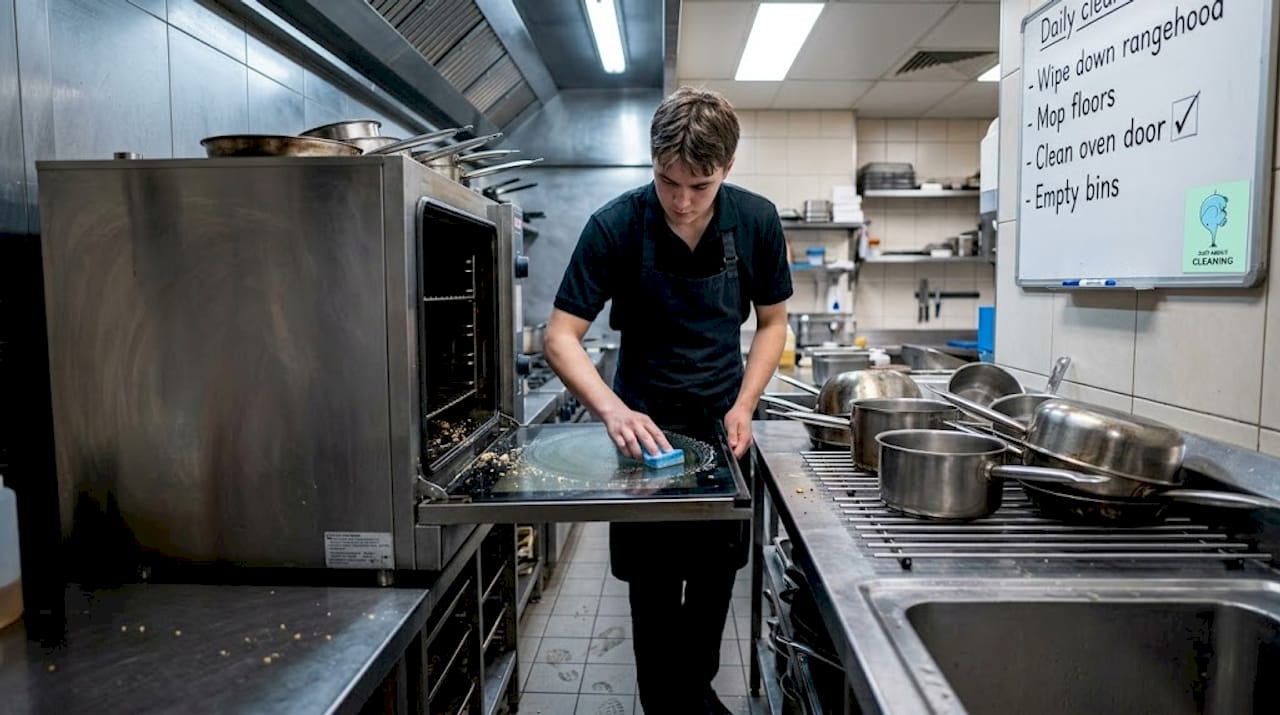
Effective hospitality cleaning is as much about timing as it is about technique. A venue that cleans thoroughly but at the wrong intervals will still accumulate compliance risk. Daily cleaning routines should cover high-touch surfaces, floors, bathrooms, and food prep areas at minimum. Weekly deep cleaning addresses grout lines, behind equipment, and hard-to-reach zones. Monthly and quarterly schedules tackle exhaust hoods, air vents, carpets, and cool room seals.
The deep cleaning process for a hospitality venue is more involved than most managers anticipate, particularly in kitchens where grease accumulation creates both a hygiene and a fire risk.
A practical frequency matrix for common venue types:
| Area | Daily | Weekly | Monthly/Quarterly |
|---|---|---|---|
| Kitchen benchtops | Yes | Deep scrub | Equipment strip-down |
| Bathrooms | Multiple times | Grout and tile scrub | Exhaust vents |
| Dining floor | Yes | Polish/strip | Carpet extraction |
| Bar surfaces | Each service | Behind equipment | Ice well sanitise |
| Cool rooms | Spot clean | Full wipe-down | Seal and drain check |
| Guest rooms (hotel) | Each checkout | Soft furnishings | Mattress and curtain clean |
Colour-coded cleaning tools are a non-negotiable in any compliant hospitality venue. Using the same mop or cloth across a bathroom and a kitchen prep area is a cross-contamination risk that auditors flag immediately. Hotel sanitation compliance guidelines recommend a strict colour system: typically red for toilets, yellow for other bathroom surfaces, blue for general areas, and green for food preparation zones.
Key scheduling strategies that work in practice:
- Clean from top to bottom in every room to avoid recontaminating surfaces
- Schedule deep cleans after trading hours to avoid disrupting guests or service
- Rotate heavy equipment cleaning so it does not all fall on the same day
- Build in buffer time between service periods for kitchen sanitation
- Document every clean with time stamps and staff sign-off for audit readiness
After-hours flexibility is particularly important for high-traffic venues. Cleaning during service creates safety risks and disrupts the guest experience. Scheduling specialist cleaning teams for late-night or early-morning slots keeps operations smooth and compliant.
Standards, metrics, and best practices
Knowing your cleaning is happening is not the same as knowing it is working. Venue managers need measurable benchmarks to assess performance and identify where standards are slipping before an auditor or a guest does.
For hotels, housekeeping efficiency benchmarks show that full-service properties should expect 12 to 16 rooms per attendant per day, with inspection pass rates of 95 to 98 percent. Defect rates should sit below 5 percent for general commercial areas and below 2 percent for food preparation zones. Cost per room for mid-range Australian hotels typically falls between $15 and $25 AUD.
Quality control tools worth implementing:
- APPA cleanliness levels: A standardised framework for assessing facility cleanliness across five levels, widely used in commercial and institutional settings
- ATP testing: Measures biological residue in relative light units (RLU); a reading under 150 to 300 RLU is the target for food contact surfaces
- Digital audit platforms: Apps that allow real-time checklist completion, photo documentation, and instant reporting
- Fluorescent gel markers: Applied to surfaces before cleaning to verify that staff are covering all required touch points
Best practices that top cleaning standards consistently highlight include using only TGA-listed, food-grade products in kitchen environments, preparing fresh sanitiser solutions each shift (dilution weakens over time), and never mixing chemicals without checking the Safety Data Sheet (SDS).
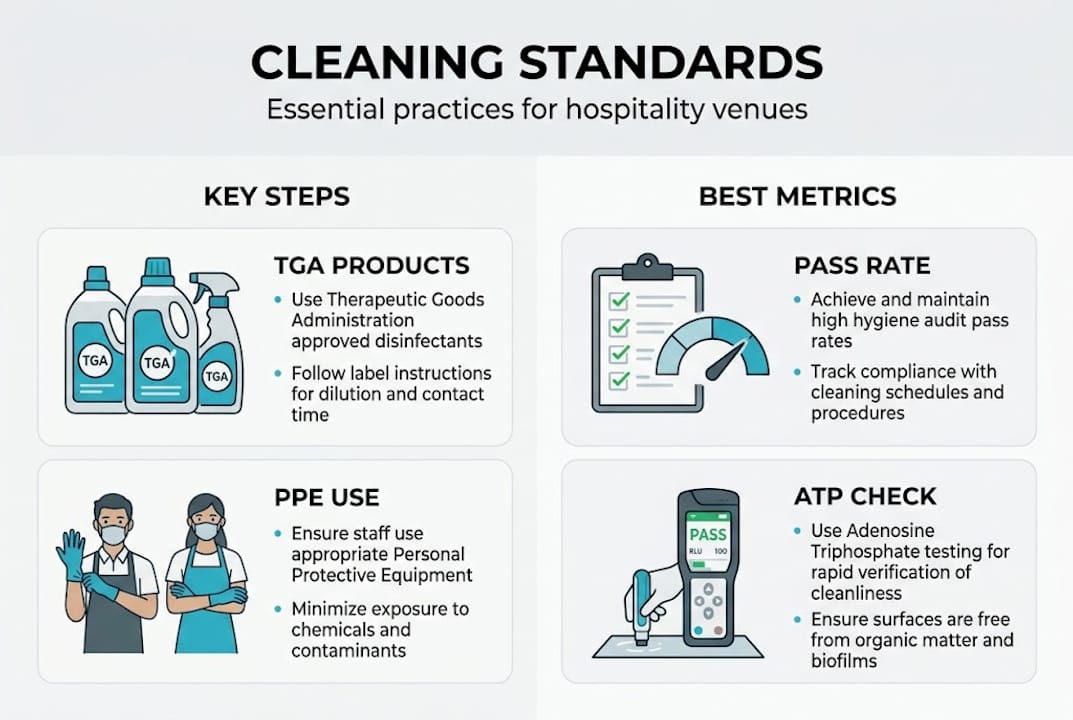
Staff training on standard operating procedures (SOPs) and correct personal protective equipment (PPE) use is equally critical. A well-written SOP is only as effective as the training behind it.
Pro Tip: A hybrid cleaning model, where routine daily cleaning is handled in-house and specialist deep cleaning is outsourced on a scheduled basis, often delivers the best balance of cost control and compliance assurance. It keeps your team focused on what they do well while bringing in expert resources for the tasks that carry the highest compliance risk.
Eco-friendly cleaning practices are also gaining real traction in hospitality. Microfibre cloths reduce chemical usage while improving surface coverage. Concentrated eco-chemicals lower waste and storage risk. Guests increasingly notice and value sustainability efforts, making green cleaning a practical business decision as well as an environmental one.
What most guides miss: Smarter cleaning for better outcomes
Most cleaning guides treat every area of a venue as equally important. In practice, that approach wastes resources and misses the areas that carry the most compliance and reputational risk. High-touch points and food preparation zones deserve disproportionate attention. A spotless dining room means very little if your kitchen benchtops are not meeting sanitisation standards.
Digital checklists and ATP audits are still underused in Australian hospitality venues, yet they are among the most cost-effective tools available for preventing compliance failures. The upfront investment is modest compared to the cost of a failed inspection or a foodborne illness incident.
The hybrid cleaning model is another insight that rarely makes it into standard guides. Routine in-house cleaning gives you day-to-day control. Outsourced specialist cleaning for deep and periodic tasks brings expertise and accountability that internal teams often cannot match. Together, they give you both flexibility and rigour.
Finally, guest feedback is a cleaning quality signal that most venues underuse. A pattern of comments about bathroom cleanliness or musty odours in guest rooms is telling you something your internal audits may have missed. Integrating sustainable cleaning practices and guest feedback loops into your cleaning schedule creates a continuous improvement cycle that lifts both compliance outcomes and guest satisfaction scores.
Connect with expert hospitality cleaning solutions
Putting these practices into action requires the right cleaning partner, not just the right intentions. Australian hospitality venues have specific compliance obligations, operational rhythms, and guest experience standards that a generalist cleaning provider may not fully understand.
At Just About Cleaning Australia, we work with hospitality venues across the country to deliver cleaning programmes built around your specific requirements. From daily kitchen sanitation to scheduled deep cleans and compliance-ready documentation, our hospitality cleaning specialists bring over 15 years of industry experience to every engagement. Reach out today to discuss a cleaning solution tailored to your venue's needs, trading hours, and compliance obligations.
Frequently asked questions
What does hospitality cleaning cover that regular cleaning does not?
Hospitality cleaning addresses industry-specific hygiene requirements, food safety compliance under FSANZ, guest experience standards, and regulatory audit obligations that routine cleaning does not account for.
How often should hotels and restaurants sanitise high-touch areas?
Kitchen high-touch surfaces require cleaning and sanitising between each service period, while bathrooms should be attended to multiple times daily in line with hospitality sector standards.
What are the legal compliance requirements for hospitality cleaning in Australia?
Venues must follow FSANZ Standard 3.2.2, which mandates a two-step cleaning and sanitising process using approved methods, with documented records available for inspection.
How can managers measure cleaning quality and effectiveness?
Quality is measured through inspection pass rates of 95 to 98 percent, defect rates below 2 percent in food areas, and ATP test readings under 150 to 300 RLU on food contact surfaces.
Is using eco-friendly cleaning products beneficial for hospitality venues?
Yes. Eco-friendly cleaning options such as microfibre and concentrated eco-chemicals reduce environmental impact and are increasingly valued by guests, making them a sound operational and reputational investment.