
TL;DR:
- Effective school hygiene management in 2026 requires customized, criteria-based cleaning plans aligned with health guidelines and ongoing performance oversight. Routine actions include daily high-touch surface cleaning, stock audits, waste management, and hygiene education, while outbreak protocols demand increased frequency and chlorine disinfectants. Regular monitoring, adaptable strategies, and strategic provider relationships are essential for maintaining high standards and safeguarding student health.
Managing school hygiene in 2026 means balancing compliance obligations, practical implementation, and genuine health outcomes for hundreds of students every day. It's not simply a matter of running a mop over the floors and emptying the bins. Victorian schools, for instance, must operate under a framework where cleaning services plans are agreed upon with providers, and principals bear responsibility for monitoring performance against those contract standards. Across Australia, administrators face mounting pressure to do more with tighter budgets, stricter expectations, and increasingly complex campuses. This article gives you evidence-backed strategies across planning, daily operations, emergency response, and performance measurement.
Table of Contents
- Key criteria for school cleaning plans
- Essential cleaning actions for everyday operations
- Emergency and outbreak cleaning: What to do differently
- Monitoring, measuring, and improving cleaning performance
- Why 'best practice' in school cleaning is about context, not just checklists
- Partnering for peace of mind: Expert help for your school
- Frequently asked questions
Key Takeaways
| Point | Details |
|---|---|
| Tailored cleaning plans | Effective school cleaning starts with a customised, criteria-based plan adapted to your campus needs. |
| Daily and emergency actions | Routine practices and clear escalation processes must coexist for everyday hygiene and emergencies alike. |
| Contract accountability | Regular performance monitoring ensures cleaning providers meet standards and adapt to changes promptly. |
| Hygiene education matters | Empowering student and staff hygiene behaviours is as important as environmental cleaning. |
Key criteria for school cleaning plans
Before you update or build a cleaning plan from scratch, you need clear criteria to guide your decisions. Without those criteria, you risk producing a plan that looks thorough on paper but fails in practice.
Every school campus is different. A primary school with 400 students, high-traffic toilet blocks, and a busy canteen has fundamentally different needs from a secondary campus with science laboratories, gym facilities, and multiple computer suites. Customisation is not optional. It is the starting point for any plan that will actually work.
When developing or reviewing your cleaning plan, consider these core criteria:
- Campus-specific risk mapping: Identify which areas carry the highest hygiene risk and set cleaning frequencies accordingly, not as a blanket standard but based on actual use patterns.
- Performance-based provider oversight: Your contract must include specific, measurable standards against which you can review your provider's work. Vague language like "clean as required" is not enforceable.
- Frequency and flexibility: High-risk areas such as toilets, sickrooms, and canteen surfaces need defined minimum frequencies with the flexibility to escalate during illness outbreaks or seasonal risk periods.
- Alignment with state and national guidelines: Cleaning plans must reflect current guidance from your state education department and, where relevant, national public health bodies.
- Staff roles and accountability: Clarify who is responsible for managing the provider relationship, logging complaints, and authorising additional cleaning when needed.
As the Victorian Cleaning Policy states, schools must work with cleaning service providers to complete and agree on a cleaning services plan, with principals or nominated staff managing provider performance against contract standards. That is a meaningful accountability structure, not just administrative paperwork.
"State-by-state differences in how education departments handle cleaning contracts mean that what works in Western Australia may not translate directly to New South Wales or Victoria. Criteria-based planning gives you a consistent framework that you can adapt to local requirements."
Reviewing cleaning protocols for schools before you finalise your plan is a practical step that many administrators overlook. Understanding what leading practice looks like gives you something concrete to benchmark against.
Essential cleaning actions for everyday operations
With clear planning criteria established, the next step is consistent daily and routine action. Routine cleaning is the foundation everything else is built on. When it is done well and done reliably, the risk of illness transmission drops, and the need for reactive emergency cleaning is reduced significantly.
The following actions represent the essential baseline for routine school hygiene:
- Clean high-touch surfaces every day, without exception. Door handles, tap fittings, light switches, desk surfaces, and shared equipment like keyboards and communal tools need daily attention. These surfaces accumulate bacteria and viruses faster than any other area in a school environment.
- Audit consumable stocks at the start of each week. Soap dispensers, paper towels, and hand sanitiser stations should be checked and restocked as a standard Monday morning task, not left until they run out mid-week when students are already present.
- Use TGA-approved products for sanitisation. Not all cleaning products are appropriate for school environments. Product selection should align with state guidance and be suitable for use around children.
- Manage waste removal daily. Bins in classrooms, toilets, canteens, and sickrooms should be emptied daily. Overflowing bins are not just an aesthetic issue. They are a genuine hygiene risk.
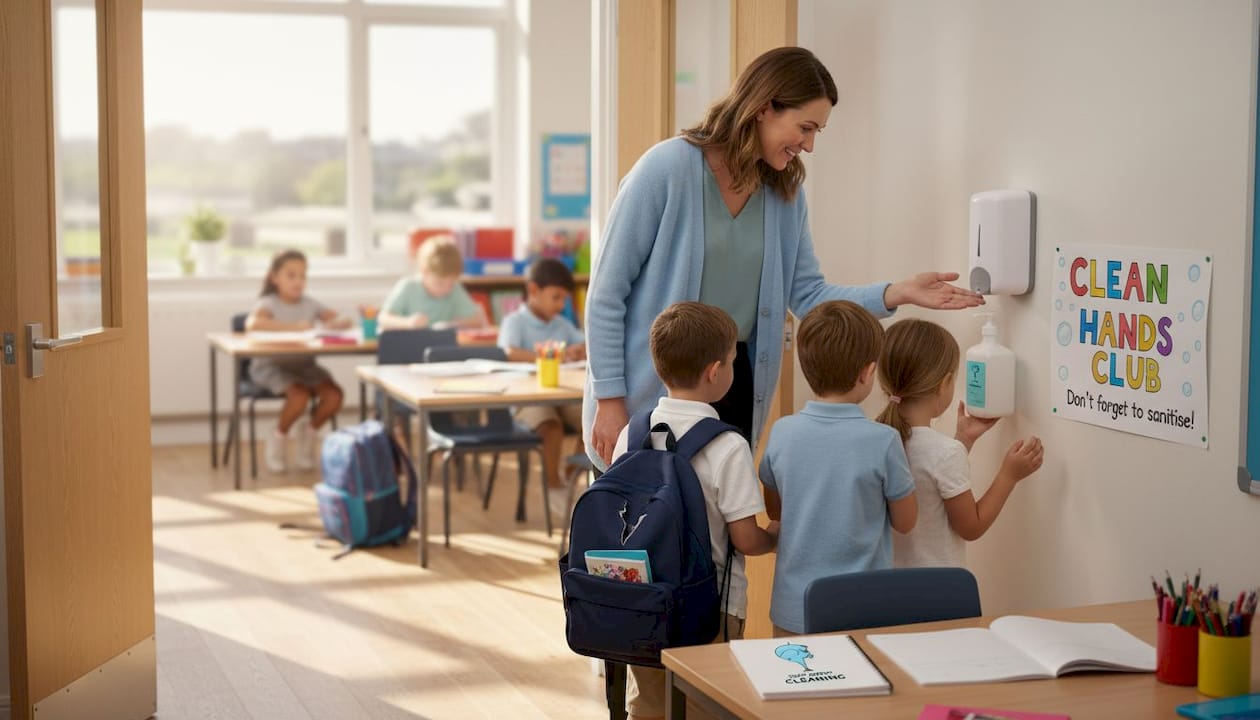
- Embed hand hygiene education into the school routine. Physical cleaning of the environment addresses only part of the hygiene equation. Teaching students correct handwashing technique, particularly before eating and after using the bathroom, is a direct intervention in illness transmission.
- Document cleaning completion. Cleaning staff should sign off on completed tasks using a log sheet or digital record. This is essential evidence when you need to review provider performance or respond to a complaint.
The Victorian Personal Hygiene Policy is explicit that school cleaning programmes must include a personal hygiene and hand hygiene consumables approach, particularly for student needs and hygiene education, not just environmental cleaning. That is a meaningful distinction. Environmental cleaning and hygiene education must work together.
For practical guidance on building these habits into your school culture, resources on school hygiene best practices and the importance of routine cleaning provide useful context you can adapt for an educational setting.
Pro Tip: Stock up quarterly on approved hand hygiene consumables. Relying on monthly orders leaves you exposed to supply delays, particularly during high-demand periods like the start of winter or immediately after school holidays.
Emergency and outbreak cleaning: What to do differently
Routine procedures will not be sufficient when your school faces a genuine hygiene emergency. Knowing when to escalate and exactly what to do differently is one of the most critical skills a facilities manager can develop.
The most common trigger for escalation in Australian schools is a gastroenteritis outbreak. Norovirus, which is frequently responsible for these outbreaks, is remarkably resilient. Norovirus can survive on surfaces for up to 28 days, meaning that standard cleaning products applied at routine frequencies will not eliminate the risk.
"When a gastroenteritis outbreak occurs, enhanced cleaning and disinfection are required, including increased frequency and specific product choices such as chlorine-based disinfectants, because other disinfectants may not kill norovirus and other viruses responsible for gastro outbreaks."
During an outbreak, the approach must change on several levels:
- Frequency: All areas, including classrooms, toilets, canteens, and common spaces, must be cleaned and disinfected at least twice every day, not once.
- Product selection: Switch to a chlorine-based disinfectant such as plain unscented household bleach. Standard disinfectants used in routine cleaning may not be effective against norovirus.
- Communication: Notify staff, parents, and your cleaning provider immediately. Outbreak response requires coordination across multiple people.
- Documentation: Record every cleaning action with timestamps and products used. This documentation is essential if the outbreak is investigated by a public health authority.
The following table summarises the core differences between routine and outbreak-level cleaning:
| Element | Routine cleaning | Outbreak response |
|---|---|---|
| Frequency | Once daily (high-risk areas twice) | Minimum twice daily, all areas |
| Product type | Standard TGA-approved detergents and disinfectants | Chlorine-based disinfectant (e.g., household bleach) |
| Focus areas | High-touch surfaces, toilets, canteens | All surfaces, with emphasis on bathrooms and shared spaces |
| Documentation | Standard sign-off logs | Detailed timestamped records with product names |
| Staff notification | Routine handover | Immediate notification to all staff and provider |
| Public health involvement | Not required | Notify local health authority if outbreak persists |
For a deeper look at responding to these situations, specialised cleaning for outbreaks outlines the service-level approaches that professional providers use during high-risk events.
Monitoring, measuring, and improving cleaning performance
Preparation and execution are only part of the equation. Without a structured approach to monitoring and measurement, even well-designed cleaning plans will drift over time. Providers lose consistency. Staff stop logging properly. Standards slip quietly, and administrators only notice when a complaint or incident forces the issue.
Effective monitoring involves several interconnected activities:
- Track attendance and illness data alongside cleaning records. If student and staff absenteeism increases without an obvious explanation, that is a signal worth investigating from a hygiene perspective.
- Conduct regular physical inspections. Walk through high-risk areas at least once a week with a structured checklist. Look for missed areas, consumable shortages, and evidence that cleaning logs are being completed honestly.
- Review provider performance quarterly. Formal reviews give you a structured opportunity to assess whether your provider is meeting contract standards. These reviews should be documented and include action items for any identified gaps.
- Gather feedback from teaching staff. Teachers and support staff notice hygiene issues that administrators may not see. A simple monthly feedback form, digital or paper, gives you ground-level intelligence about what is and is not working.
- Adapt the plan when conditions change. A new building wing, a change in student numbers, or an updated state guideline all require you to revisit and update your cleaning plan.
The Victorian Cleaning Policy establishes that contract-based models, including cleaning services plans and provider performance management, are a practical mechanism administrators can use to keep standards measurable and enforceable. Treat the contract not as a set-and-forget document but as a living framework you actively manage.
The following table shows the key items worth tracking in your monitoring programme:
| Monitoring item | How to track | Review frequency |
|---|---|---|
| Cleaning task completion | Provider sign-off logs | Weekly |
| Consumable stock levels | Weekly stocktake by nominated staff | Weekly |
| Staff and student absenteeism | Administration records | Monthly |
| Provider performance | Formal contract review | Quarterly |
| Incident and complaint log | Written records with outcomes | As incidents occur |
| Guideline and policy updates | State department communications | Annually or as published |
For practical guidance on compliance monitoring, compliance monitoring strategies provides a useful framework you can adapt to your campus context.
Pro Tip: Schedule quarterly reviews with your cleaning provider as a standing calendar commitment, not an ad hoc meeting. This signals that performance management is ongoing and non-negotiable, which tends to lift provider accountability noticeably.
Why 'best practice' in school cleaning is about context, not just checklists
There is a tendency in facilities management to treat best practice as a fixed list of tasks that, once completed, guarantee a good outcome. In school cleaning, that thinking is genuinely risky.
We have seen campuses where every box on the checklist was ticked, every log was signed, and yet hygiene outcomes were poor because the checklist was designed for a different campus with different risk patterns. The school had compliance on paper but not in practice.
The value of professional cleaning comes not from the fact that a cleaner showed up and completed tasks, but from the active management of those tasks against a standard that actually reflects the school's real needs. That distinction is what separates schools that manage hygiene effectively from those that are perpetually reactive.
In 2026, two things have become clearer than ever. First, adaptability matters more than any fixed protocol. Schools that can shift from routine to outbreak-level response quickly, without scrambling to find a product or brief a provider who is not across the situation, are the ones that protect their communities most effectively. Second, supplier relationships are a genuine strategic asset. A cleaning provider who understands your campus, knows your risk areas, and communicates proactively is worth significantly more than the lowest tender price.
Do not mistake compliance for effectiveness. Compliance tells you that a process was followed. Effectiveness tells you whether the outcome was actually achieved. The administrators who produce the best hygiene results in Australian schools are the ones who measure both and are honest about the difference.
Partnering for peace of mind: Expert help for your school
Getting your school's cleaning programme right in 2026 takes more than good intentions. It takes the right partner, the right processes, and the confidence that your provider is as invested in your school's hygiene outcomes as you are.
At Just About Cleaning Australia, we work with educational facilities across Australia to build cleaning programmes that are genuinely tailored, compliance-ready, and backed by more than 15 years of professional experience. Our trained onsite crews understand the specific demands of school environments, from high-traffic toilet blocks to specialist learning areas. If you are ready to move beyond generic contracts and reactive management, the commercial school cleaning experts at Just About Cleaning Australia are here to help you build something that actually works. Reach out today to discuss a cleaning services plan that fits your campus.
Frequently asked questions
What is the minimum standard for routine school cleaning in 2026?
Schools must meet the contractually agreed minimum frequencies set out in their cleaning services plan, with the flexibility to adjust those frequencies upward when hygiene risks increase. The Victorian Cleaning Policy requires principals to actively manage provider performance against these agreed standards.
How should schools respond to a gastroenteritis outbreak?
During an outbreak, all areas must be cleaned and disinfected at least twice every day using a chlorine-based disinfectant, because norovirus can survive on surfaces for up to 28 days and standard disinfectants may not be effective against it.
Should students be involved in hygiene education?
Yes, ongoing hygiene education for students is an essential part of any school cleaning programme. Personal hygiene policy guidance makes clear that hand hygiene education and consumable access for students must be included alongside environmental cleaning.
How do cleaning contracts help maintain high standards?
Contracts establish clear, measurable performance expectations that allow administrators to hold providers accountable over time. The cleaning services plan model gives principals a practical and enforceable mechanism for maintaining standards rather than relying on informal arrangements.