
TL;DR:
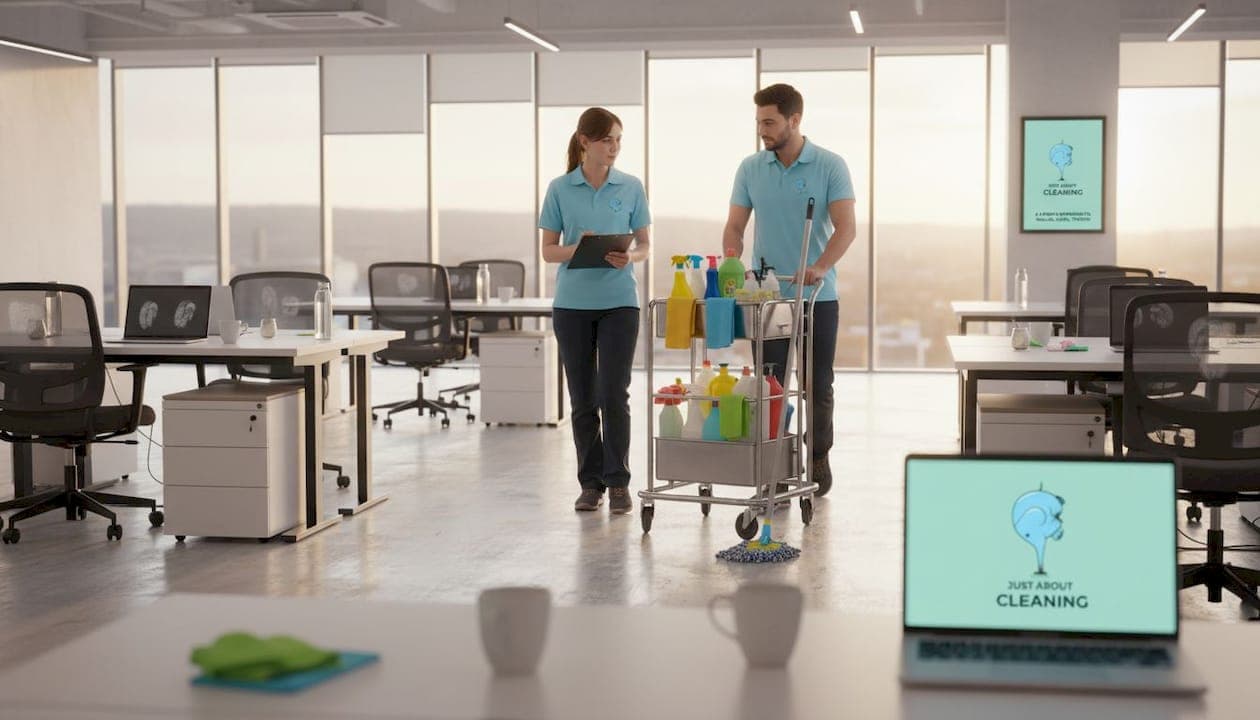
- Many Australian businesses are shifting to outsourcing office cleaning to reduce HR and compliance burdens while ensuring consistent quality. Outsourcing involves engaging a third-party provider for a comprehensive range of cleaning services, backed by detailed contracts and ongoing performance reporting. The key to success is selecting a provider that guarantees WHS compliance, backup staffing, and clear service standards, ultimately delivering more reliable, scalable, and cost-effective cleaning solutions.
Many business owners assume that keeping cleaning in-house gives them more control and saves money. In practice, the opposite is often true. Managing an internal cleaning team adds HR obligations, compliance risk, and ongoing supply costs that quietly erode your bottom line. Across Australia, businesses of every size are shifting towards professional outsourced cleaning arrangements, and the evidence behind this trend is compelling. This article walks you through exactly what outsourcing involves, why businesses are making the switch, how to compare your options honestly, and what to include in a contract to protect your operations from day one.
Table of Contents
- What does outsourcing office cleaning involve?
- The main reasons businesses outsource office cleaning
- Comparing in-house cleaning versus outsourcing: pros and cons
- How to ensure compliance and quality when outsourcing
- What most decision-makers get wrong about outsourcing office cleaning
- Take the next step: outsource your cleaning with confidence
- Frequently asked questions
Key Takeaways
| Point | Details |
|---|---|
| Boosts hygiene standards | Outsourcing ensures consistent and professional office cleaning. |
| Reduces admin workload | External providers handle recruitment, training, and backup staffing for you. |
| Simplifies WHS compliance | Professional cleaners are trained to meet workplace health and safety requirements. |
| Flexible and scalable | Easily adjust cleaning scope and frequency as your business grows. |
What does outsourcing office cleaning involve?
Outsourcing office cleaning means engaging a third-party provider to manage your cleaning requirements, whether routine or specialised, rather than employing cleaning staff directly. For most Australian businesses, this relationship begins with a scoping conversation where the provider assesses your premises, frequency needs, and any sector-specific requirements such as healthcare hygiene standards or retail foot-traffic considerations.
The scope of services available is broader than many expect. Beyond standard daily or weekly cleans, professional providers can handle:
- Routine office cleaning (vacuuming, sanitising, waste removal)
- Deep cleans and periodic intensive maintenance
- COVID-19 and infection-control cleaning protocols
- WHS-compliant hazardous waste disposal
- Specialised cleaning for high-traffic or sensitive environments
Understanding the full range of cleaning service types available helps you scope correctly from the start, avoiding gaps in coverage or unnecessary duplication.
The typical outsourcing process follows five clear steps: scoping, quoting, contracting, onboarding, and ongoing performance reporting. Each stage matters. Scoping defines what needs doing and how often. Quoting sets cost expectations. Contracting locks in your protections, including WHS obligations, performance standards, and backup staffing arrangements. Onboarding ensures the provider's team understands your premises and any site-specific requirements. Reporting keeps quality accountable over time.
"Edge cases like multi-site operations benefit from consolidated management, while small offices favour outsourcing for scalability without HR burdens."
This is a critical point for property managers overseeing multiple locations. A single provider relationship can standardise cleaning quality across sites, simplify invoicing, and reduce the administrative overhead of managing separate cleaning staff at each premises.
The main reasons businesses outsource office cleaning
With the outsourcing process defined, we can now examine what motivates companies to make this shift, including efficiency, compliance, and specialist expertise.
The most immediate driver is operational efficiency. When you outsource, you eliminate the admin burden of rostering, leave management, and sourcing cleaning supplies. Your operations team focuses on what it does best, rather than fielding complaints about missed bins or empty soap dispensers. For businesses with office cleaning efficiency as a priority, this reduction in management overhead is significant and measurable.
Staff productivity is another strong motivator. When your employees are not picking up cleaning duties informally or waiting on unreliable in-house cleaners, they stay focused on their core roles. Research consistently links clean, well-maintained workplaces to lower absenteeism and higher staff morale. A visibly hygienic environment also signals to clients and visitors that your business operates to a high standard.
Key reasons businesses move to outsourced cleaning include:
- Cost predictability: Fixed or clearly scoped contracts make budgeting straightforward, removing the fluctuating costs of direct employment
- Professional standards: Trained crews bring industry-grade equipment, technique, and product knowledge that in-house staff rarely match
- Compliance assurance: Providers with established WHS protocols reduce your liability exposure significantly
- Scalability: Coverage scales up or down based on your needs, whether you add a new site or reduce operations seasonally
- Backup capacity: Professional providers have staffing reserves, so cleaning does not lapse when individuals are sick or on leave
As noted in facilities management guidance, outsourcing for scalability without the HR burdens of direct employment is a key reason smaller offices favour this model, and always including WHS compliance and backup staffing provisions in contracts is strongly recommended.
Pro Tip: When evaluating providers, ask specifically about their WHS management system and how they handle staff absences. A provider without a documented backup plan is a compliance and coverage risk for your business.
Using professional cleaners for safety also means your premises are maintained to Australian safety standards without requiring your management team to build that expertise internally.
Comparing in-house cleaning versus outsourcing: pros and cons
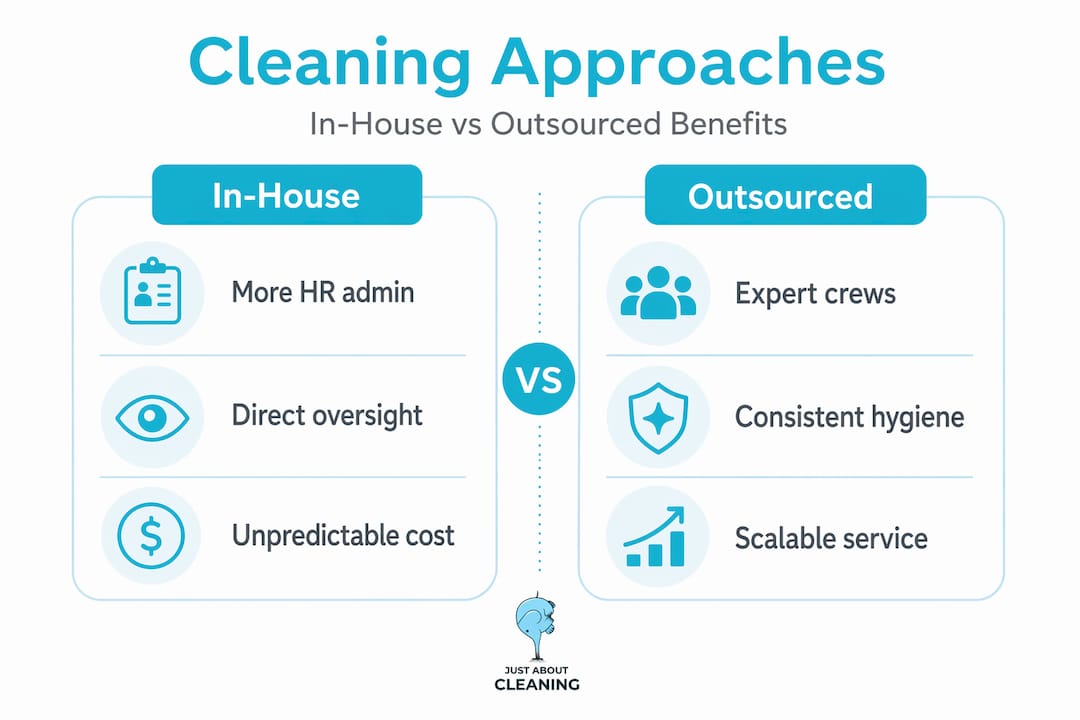
Now that the drivers are established, let's compare how the alternatives stack up in key operational areas.
| Aspect | In-house cleaning | Outsourced cleaning |
|---|---|---|
| Cost structure | Variable; includes wages, super, leave, supplies | Fixed or contracted; easier to budget |
| Compliance responsibility | Fully on the business owner/employer | Shared; provider holds WHS obligations |
| Flexibility | Limited by staff availability and rosters | High; scalable to site size and need |
| Quality control | Dependent on individual staff | Governed by SLAs and performance audits |
| Responsiveness | Slow if staff absent or understaffed | Fast; backup staffing protocols apply |
| HR management | Full employer obligations apply | None; provider manages their own staff |
| Specialist capability | Usually limited to general cleaning | Access to specialised and deep cleaning |
Pros of in-house cleaning:
- Direct oversight of staff on site
- Immediate communication when issues arise
- No dependency on external contract terms
Cons of in-house cleaning:
- Full employer obligations including superannuation, leave entitlements, and payroll
- Compliance complexity under Australian WHS laws
- Coverage gaps when staff are absent, particularly in smaller teams
- Ongoing supply procurement and equipment maintenance costs
Pros of outsourcing:
- Predictable costs and streamlined budgeting
- Reduced HR administration and legal risk
- Access to trained, experienced crews with specialist equipment
- Guaranteed coverage through backup staffing arrangements
Cons of outsourcing:
- Requires careful contract scoping to avoid gaps
- Less immediate visibility of daily cleaning activities
- Quality depends heavily on provider selection
Pro Tip: Review your office cleaning standards requirements before going to market. Understanding what hygiene benchmarks apply to your sector means you can evaluate provider credentials accurately rather than accepting generic proposals.
Consolidated management and scalability are key benefits for outsourcing, while in-house models increase HR and compliance complexity, particularly as headcount and site numbers grow. It is also worth noting that ancillary facility costs, such as AC servicing frequency, are similarly more manageable when handled by specialist providers, a principle that extends directly to cleaning.
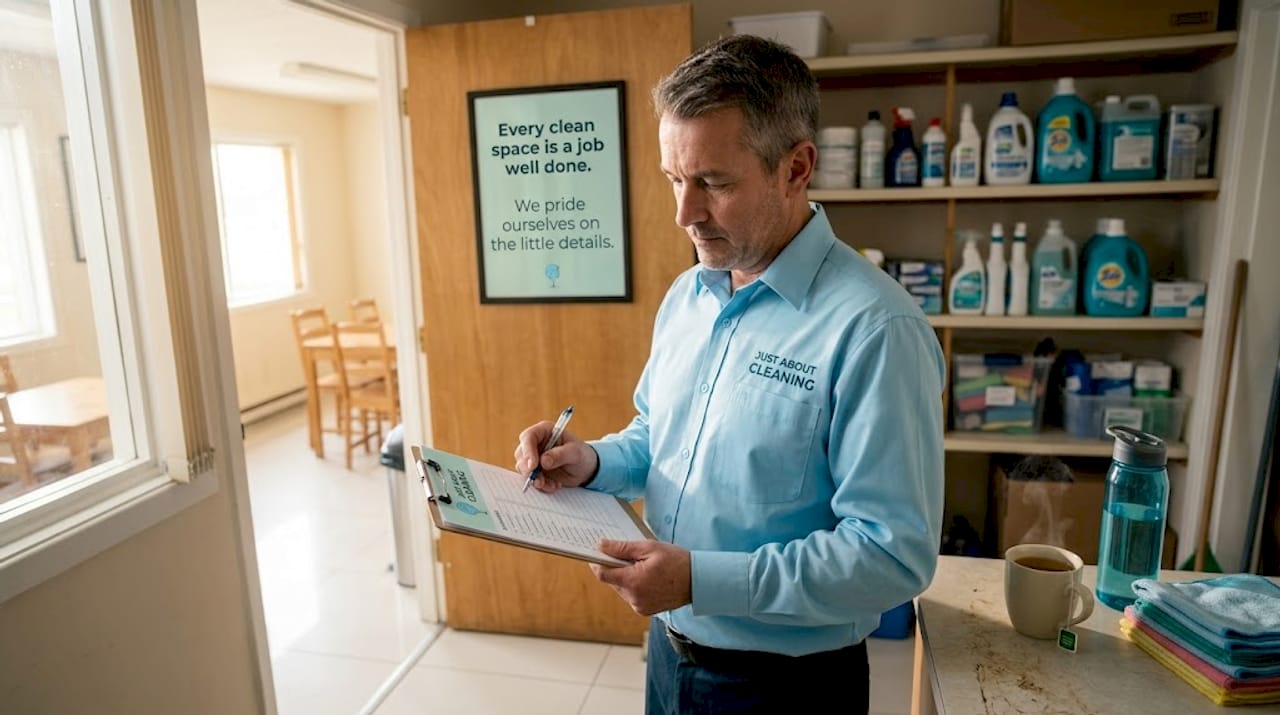
Understanding how cleaning drives workplace safety is essential when weighing up the compliance dimension of each model. The in-house option carries full liability; the outsourced option distributes it far more favourably.
How to ensure compliance and quality when outsourcing
Comparing the options is just the start; here is how to execute office cleaning outsourcing effectively and legally.
Getting compliance right starts at the contract stage. Many businesses make the mistake of treating cleaning agreements as simple service arrangements, when in fact they carry genuine legal and safety implications under Australian WHS legislation. A well-structured contract is your primary protection.
Follow this checklist when reviewing or negotiating your cleaning contract:
- Confirm WHS compliance obligations are explicitly assigned to the provider, including risk assessments, incident reporting, and product safety data sheets
- Define the scope of work in detail, including frequency, areas covered, and standard of finish expected for each task
- Include backup staffing provisions so service continuity is guaranteed when individual cleaners are unavailable
- Specify reporting requirements, such as site visit logs, completion records, and escalation procedures for missed tasks
- Require evidence of staff training, including hygiene, chemical handling, and any sector-specific certifications
- Set performance review intervals, whether monthly, quarterly, or triggered by specific incidents
- Include a clear variation process for scope changes such as new sites, additional areas, or seasonal deep-clean requirements
"Always include WHS compliance and backup staffing in contracts." — Facilities management best practice from JKFM
Performance auditing is equally important once the contract is live. Documented reporting keeps providers accountable and gives you early warning when standards are slipping. The following table outlines the quality indicators that should be tracked and how frequently:
| Quality indicator | Recommended review interval |
|---|---|
| Site visit completion logs | Weekly |
| Hygiene standard inspections | Monthly |
| Chemical and product safety compliance | Quarterly |
| Staff training records | Bi-annually |
| WHS incident reports | As they occur, with monthly summary |
| Client satisfaction feedback | Quarterly |
Following a robust cleaning compliance guide ensures your outsourcing arrangement does not simply shift the risk to your provider in writing while leaving gaps in practice. Equally, hygienic cleaning compliance considerations, particularly in healthcare-adjacent or food-handling environments, must be reflected clearly in both the contract and the provider's operational procedures.
Require that any provider you engage can demonstrate their risk management framework before you sign. Ask to see their WHS policy, their chemical register, and their training documentation. A reputable provider will share these readily.
What most decision-makers get wrong about outsourcing office cleaning
Most decision-makers frame the outsourcing question as a cost comparison: what does it cost per hour in-house versus what the provider quotes? This framing misses the real operational picture almost entirely.
The assumption behind in-house cleaning is that direct employment equals control. In practice, control requires systems, training, oversight, and accountability structures. Most businesses do not build those systems for their cleaning function. They hire a cleaner, give them a list, and assume quality will follow. When it does not, the response is to add more informal supervision, which is time your management team did not budget for.
Professional outsourced providers, by contrast, operate with documented procedures, trained crews, and performance accountability built into their service model. The industrial cleaning practices that underpin high-risk environments also inform best practice across commercial office settings, meaning the expertise gap between a trained provider and an ad hoc internal arrangement is far wider than most business owners realise.
Consider multi-site operations specifically. Consolidated management under a single outsourced provider means standardised quality, unified reporting, and a single point of accountability. Replicating that with separate in-house cleaners at each site requires a level of HR infrastructure most organisations are simply not set up to manage efficiently.
There is also the productivity dimension. Inconsistent cleaning, lingering odours, dirty bathrooms, and cluttered common areas all affect how staff feel about their workplace. These are not trivial concerns. They translate into real impacts on morale, retention, and the impression you make on clients. Businesses that underinvest in cleaning often overestimate how well their teams tolerate it.
Our experience across more than 15 years of commercial cleaning tells us that the businesses most satisfied with outsourcing are those that treated the provider relationship seriously from the start, with clear expectations, robust contracts, and regular communication. The ones who struggled were those who viewed outsourcing purely as a cost-cutting measure and under-specified their requirements.
The real value of outsourcing is not just what it costs. It is what it reliably delivers, consistently, across every site, every shift, and every inspection.
Take the next step: outsource your cleaning with confidence
If this article has clarified how outsourcing works and what to look for in a provider, the practical next step is finding a team that can deliver consistently across your specific sector and site requirements.
Just About Cleaning Australia has over 15 years of experience supporting Australian businesses with professional office cleaning solutions built around compliance, reliability, and genuine sector expertise. Whether you operate a single office or a national multi-site portfolio, our trained crews work to documented WHS standards, with full backup staffing and transparent reporting built into every engagement. From small business to large corporate environments, we tailor our service scope to what your operations actually need. Reach out today for an obligation-free site evaluation and tailored quote, and take the guesswork out of keeping your workplace clean, safe, and audit-ready.
Frequently asked questions
How do I know if my business is ready to outsource cleaning?
If internal resources are stretched, compliance obligations are growing, or cleaning quality is inconsistent, outsourcing is a practical and scalable next step. As facilities management experts note, small offices favour outsourcing for scalability without the HR burdens of direct employment.
What are the legal compliance risks if I outsource cleaning?
The main risks involve failing to confirm that your provider meets their WHS obligations and leaving backup staffing arrangements out of the contract. Best practice guidance consistently recommends that businesses include WHS compliance and backup staffing provisions explicitly in every cleaning contract.
Is it more expensive to outsource than to keep cleaning in-house?
Outsourcing typically delivers more predictable costs and is often cheaper in total once you account for wages, superannuation, leave entitlements, supplies, and compliance management for an in-house arrangement. In-house models increase HR and compliance complexity in ways that many business owners underestimate at the outset.
What should a cleaning contract always include?
A robust cleaning contract should cover the detailed scope of work, WHS compliance obligations, backup staffing provisions, performance reporting requirements, and staff training standards. Facilities management best practice is clear that WHS compliance and backup staffing must be written into the contract, not simply assumed.