
TL;DR:
- Proper infection control cleaning involves systematic procedures that eliminate pathogens to prevent staff illness and outbreaks. It requires trained staff, validated disinfectants, correct contact times, thorough documentation, and verification through audits and testing. Implementing these standardized practices ensures compliance, reduces infection risks, and maintains a safe environment across various facilities.
Failing to follow a proper infection control cleaning process doesn't just leave surfaces looking dirty. It creates real risks: staff illness, regulatory non-compliance, and the kind of outbreak that damages a business's reputation for years. Whether you manage a healthcare facility, office, childcare centre, or commercial space, understanding what is infection control cleaning — and how to do it correctly — is non-negotiable. This guide walks you through every stage, from preparation through to verification, so your organisation can meet modern hygiene standards with confidence.
Table of Contents
- Key takeaways
- Getting ready: preparation for infection control cleaning
- Step-by-step: executing the cleaning process
- Common pitfalls and how to avoid them
- Verifying effectiveness and maintaining compliance
- My take on what actually works in practice
- How Just About Cleaning can help your facility
- FAQ
Key takeaways
| Point | Details |
|---|---|
| Preparation is non-negotiable | Correct PPE, trained staff, and appropriate disinfectants must be in place before cleaning begins. |
| Follow a systematic method | Always clean from clean to dirty, high to low, and outside to inside to prevent cross-contamination. |
| Contact time matters | Disinfectants only work when left on surfaces for the correct duration — skipping this step undermines the process. |
| Auditing reveals real gaps | Approximately 50% of surfaces are inadequately disinfected without strong protocols and regular auditing. |
| Verification closes the loop | Cleaning logs, compliance audits, and observer checks confirm that your process is working, not just documented. |
Getting ready: preparation for infection control cleaning
Before a single surface is wiped down, the groundwork for an effective infection control cleaning process must be laid. Businesses that skip this stage often find their efforts fall short, not because of the wrong products, but because the conditions for success were never established.
Supplies, disinfectants, and equipment
The products you choose determine what pathogens you can actually eliminate. Not every disinfectant works against every microorganism. Selecting products approved by the Therapeutic Goods Administration (TGA) in Australia, or those aligned with EPA-validated disinfectants internationally, gives you confidence that the chemistry is proven.
| Product category | Examples | Key requirement |
|---|---|---|
| Disinfectants | Quaternary ammonium, chlorine-based solutions | Must have validated contact times |
| Cleaning cloths | Colour-coded microfibre cloths | Separate colours per zone to avoid cross-contamination |
| Mops and buckets | Flat microfibre mops with separate buckets | Replace mop heads between high-risk areas |
| PPE | Gloves, gowns, masks, eye protection | Match PPE level to the risk of the area being cleaned |
| Waste disposal | Biohazard bags, sealed containers | Use correct bags for contaminated waste |
Personal protective equipment selection
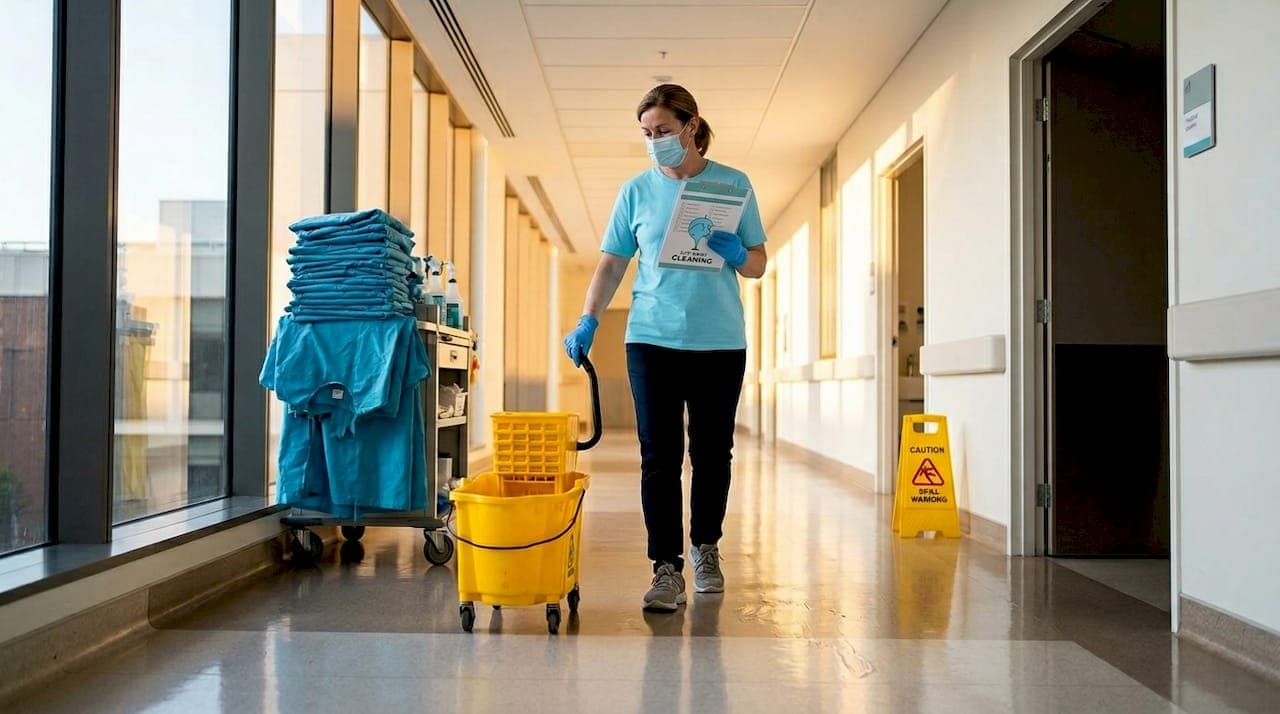
PPE is not a formality. It protects your cleaning staff from pathogen exposure while also preventing them from inadvertently transferring contaminants between areas. For high-risk environments such as isolation rooms or healthcare settings, heavy-duty gloves, gowns, and N95 respirators are the recommended standard. For lower-risk commercial spaces, gloves and aprons may suffice. The key is matching the PPE to the assessed risk level of each zone in your facility.
Staff training and protocols
Training and preparation strongly correlate with successful cleaning outcomes. Staff who understand not just what to clean but why each step matters are significantly more consistent in their practice. Written, standardised protocols give every team member a clear reference point and reduce the variability that allows contamination to persist. You can find a useful overview of how checklists and protocols integrate into real cleaning practice in this cleaning checklist resource for facility managers.
Facility preparation
Removing unnecessary equipment and minimising fabric furniture in high-risk areas reduces the number of surfaces that harbour pathogens. Fabric is notoriously difficult to disinfect and acts as a reservoir for microorganisms. Before cleaning begins, clear the space, close ventilation vents where required, and place wet floor signs.
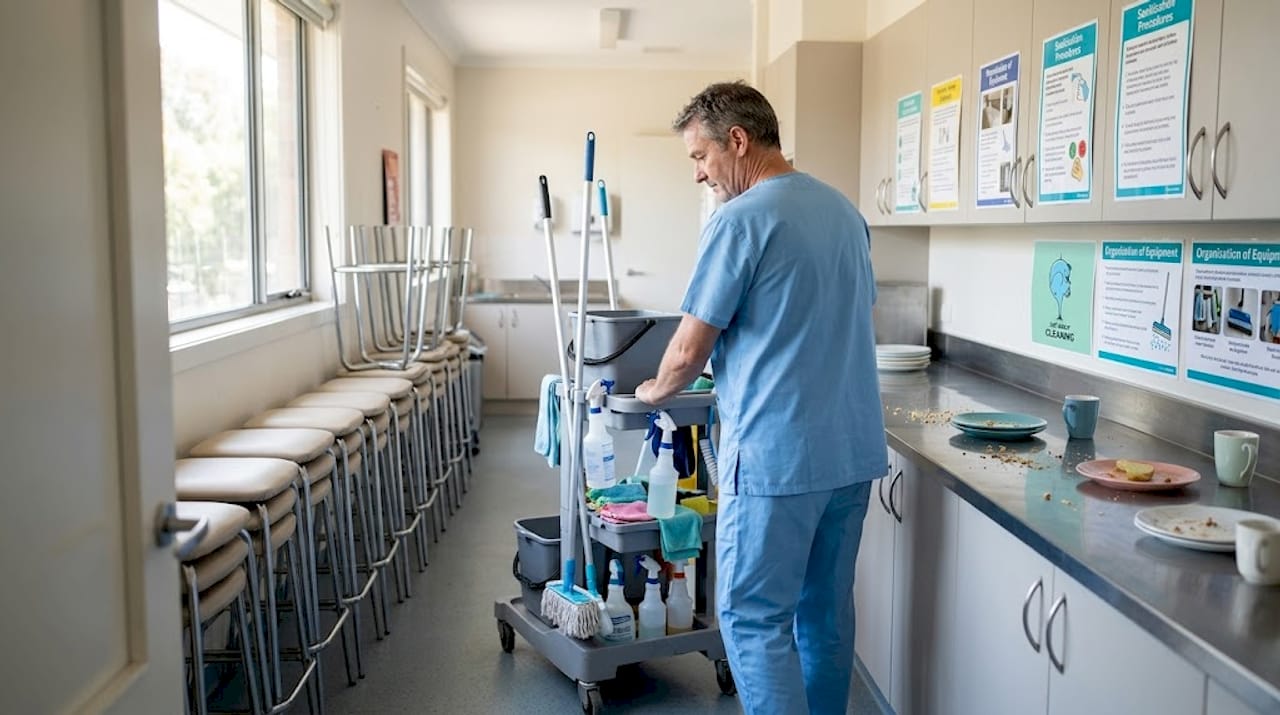
Pro Tip: Colour-code your cleaning cloths and mops across different facility zones — for example, red for toilets, blue for general areas, and green for food preparation zones. This single system prevents cross-contamination between areas without requiring constant verbal reminders.
Step-by-step: executing the cleaning process
Understanding what infection control is — protecting people from the spread of infectious agents — makes the logic of these steps clear. Every decision in the execution phase is designed to move contamination away from people and out of the environment without spreading it further.
The three core principles
Good disinfection cleaning methods all share the same structural logic:
- Clean to dirty: Start in the cleanest areas and work towards the most contaminated zones. This stops you carrying pathogens back into areas you have already cleaned.
- High to low: Clean elevated surfaces first — shelves, benchtops, light switches — so that any debris falls to the floor and is picked up during the final floor clean.
- Outside to inside: Begin at the perimeter of a room and work inward, finishing near the door so you exit without re-contaminating surfaces.
Two-step versus combined cleaning and disinfection
The two-step method cleans surfaces first to remove organic matter, then applies a disinfectant as a second pass. This approach is more thorough and is recommended for healthcare and high-risk commercial environments because organic soil can render disinfectants ineffective. Combined products that clean and disinfect in a single step are acceptable for lower-risk routine settings but must not be used as a shortcut where the contamination burden is high.
Using disinfectants correctly
Product selection and correct contact times are critical for killing pathogens effectively. Contact time is the minimum duration the disinfectant must remain visibly wet on a surface to achieve the kill claim on its label. Many cleaning staff apply a disinfectant and immediately wipe it off, invalidating the entire step. Some products require surfaces to remain wet for as long as 10 minutes.
Pro Tip: Always read the product label for contact time before starting, not after. Post a laminated contact time reference sheet in your cleaning supply area so staff can check quickly during their shift.
Terminal cleaning after high-risk occupancy
Terminal cleaning is significantly more thorough than routine cleaning and covers all surfaces, equipment, and room areas after a space has been vacated by someone who posed an infection risk. This is standard in healthcare settings after patient discharge but is also relevant in commercial contexts after a confirmed illness event. Every surface, including the undersides of furniture, door handles, and wall areas near contact zones, must be addressed.
Wet methods and avoiding aerosolisation
Dry dusting or sweeping releases particles back into the air, increasing occupant exposure rather than reducing it. Wet microfibre cloths and damp mops trap contaminants rather than dispersing them. Infectious disease cleaning steps must always use wet methods in areas where pathogen load is a concern.
Cleaning logs and documentation
A completed cleaning log provides accountability and supports compliance. Record the area cleaned, the products used, the staff member responsible, and the time of completion. These records are auditable and provide evidence of due diligence during inspections or following an incident.
Common pitfalls and how to avoid them
The gap between a cleaning process that looks good on paper and one that actually prevents infection is wide. These are the failure points that matter most.
- Inadequate training: Staff who have not been trained in infection prevention cleaning will default to habitual practices that may be incorrect. Regular refresher sessions are not optional.
- Wrong disinfectant choice: Not all disinfectants are effective against all pathogens. Confirm that your chosen product has a demonstrated efficacy against the organisms relevant to your facility type.
- Skipping contact time: This is the single most common error in commercial cleaning for infections. The disinfectant must remain on the surface for the specified time to work.
- Dry sweeping and vacuuming: Without appropriate HEPA filtration, vacuuming can disperse fine particulate matter including pathogens. This worsens indoor air quality rather than improving it.
- Neglecting high-touch surfaces: Door handles, light switches, tap fittings, lift buttons, and shared equipment accumulate the highest microbial load. These areas require more frequent attention than walls or floors.
- Poor ventilation management: Indoor air can be two to five times more polluted than outdoor air. Infection prevention cleaning must include air quality measures such as HEPA filtration and adequate air exchanges. See also how effective air quality management integrates with your cleaning programme.
Cleaning logs often under-represent real contamination risks. True effectiveness requires standardised, audited protocols with verification steps built into the process — not just records of tasks completed. Source
Pro Tip: Conduct a quarterly internal walk-through audit using a standardised checklist. Have a staff member not involved in routine cleaning carry out the check to get an objective assessment of what is actually happening on the floor.
Verifying effectiveness and maintaining compliance
Cleaning must be verified, not assumed. A signed log confirms that a task was completed. It does not confirm that it was done correctly or that the outcome achieved the required hygiene standard.
Compliance monitoring tools and practices
| Verification method | Purpose | Frequency |
|---|---|---|
| Cleaning observer rounds | Confirm correct technique and product use by staff | Weekly or after new staff onboarding |
| ATP bioluminescence testing | Measures biological contamination on surfaces | Monthly in high-risk areas |
| Cleaning logs and data records | Provides documented evidence of tasks and products | After every cleaning session |
| Internal audits | Identifies systemic gaps in protocol adherence | Quarterly |
| Staff refresher training | Reinforces correct technique and updates on new standards | At least twice per year |
Standards and metrics in the Australian context
In Australian healthcare and commercial settings, infection control as a systematic practice encompasses environmental cleaning alongside hand hygiene, PPE use, and antibiotic stewardship. Facilities operating under the National Safety and Quality Health Service (NSQHS) Standards are required to demonstrate documented evidence of their cleaning processes and outcomes. For businesses outside healthcare, cleaning standards aligned with Australian compliance requirements apply across office, retail, and industrial settings.
The outcomes you should be tracking include reduction in reported illness among staff, fewer infection-related incidents, and consistent performance in cleaning audits over time. Facilities that adopt strong cleaning standards can achieve measurably lower infection rates. These are concrete results, not just cleaner-looking spaces.
My take on what actually works in practice
By David
I've spent years working alongside facilities managers and business owners who are genuinely committed to doing infection control cleaning well. What I've observed consistently is that the hardest part is not the chemistry or the equipment. It's the human element.
In my experience, organisations that get this right are not necessarily the ones with the most expensive products or the most detailed written policy. They are the ones where cleaning staff understand the purpose behind every step they take. When a cleaner knows that skipping contact time on a disinfectant is functionally the same as not disinfecting at all, they don't skip it. That kind of understanding has to come from training, from regular reinforcement, and from a management culture that treats cleaning as the safety function it actually is.
What I've found frustrating to watch is the assumption that a signed cleaning schedule equals a clean facility. Studies suggest around 50% of surfaces remain inadequately disinfected in environments without audited protocols. That figure should alarm any facilities manager. Documentation matters, but it cannot substitute for verification.
My practical advice: build your verification steps before you finalise your protocols. Decide how you will know the process is working, then design your cleaning programme around delivering those outcomes. That sequence produces far better results than writing procedures first and hoping the evidence follows.
— David
How Just About Cleaning can help your facility
Implementing a rigorous infection control cleaning process takes more than good intentions. It requires trained personnel, approved products, documented protocols, and a partner who understands compliance requirements across Australian industry sectors.
Just About Cleaning has been supporting businesses across Australia for over 15 years, delivering infection prevention cleaning services for healthcare, education, commercial, and industrial environments. Their onsite crews follow standardised cleaning protocols for infections, use certified disinfectants with validated contact times, and maintain thorough cleaning records to support your compliance obligations.
If your organisation needs a reliable partner for professional infection control services, Just About Cleaning brings the expertise, accountability, and consistency that this kind of work demands. Get in touch to discuss a cleaning solution tailored to your facility's needs.
FAQ
What is infection control cleaning?
Infection control cleaning is a structured cleaning and disinfection process designed to eliminate or reduce pathogens in a facility environment. It goes beyond general cleaning by using approved disinfectants, correct methodology, and systematic protocols to prevent the spread of infectious disease.
How is infection control cleaning different from routine cleaning?
Routine cleaning removes visible dirt and maintains general hygiene. Infection control cleaning includes targeted disinfection with validated products, correct contact times, and systematic technique to address microbial contamination that routine cleaning does not reliably eliminate.
What are the key steps in the infection control cleaning process?
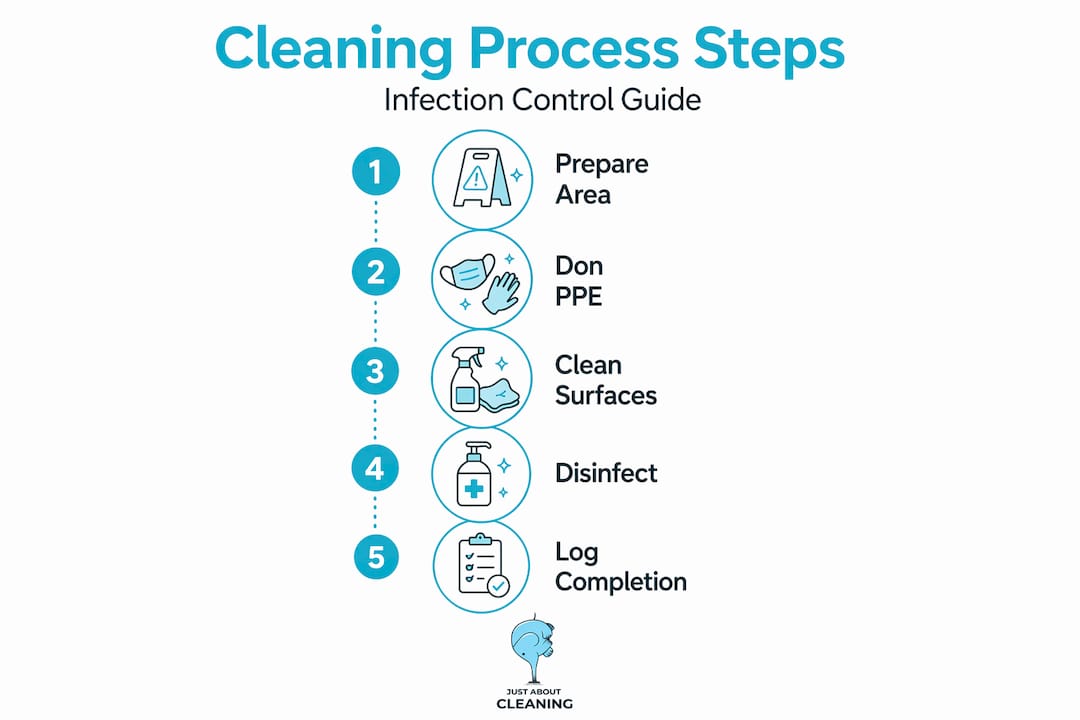
The core steps are: prepare the area and staff with correct PPE and products, clean surfaces to remove organic matter, apply disinfectant and observe the required contact time, work from clean to dirty and high to low throughout the space, and document the process for compliance and accountability.
Why does disinfectant contact time matter?
Contact time is the minimum period a disinfectant must remain wet on a surface to achieve its stated pathogen kill rate. Wiping a surface immediately after applying the product means the chemistry has not had sufficient time to work, leaving the surface inadequately disinfected.
How can businesses verify their infection control cleaning is effective?
Verification methods include ATP bioluminescence surface testing, compliance audits using standardised checklists, cleaning observer rounds, and tracking outcomes such as staff illness rates. Audited and standardised protocols dramatically improve surface cleanliness compared to undocumented approaches.