
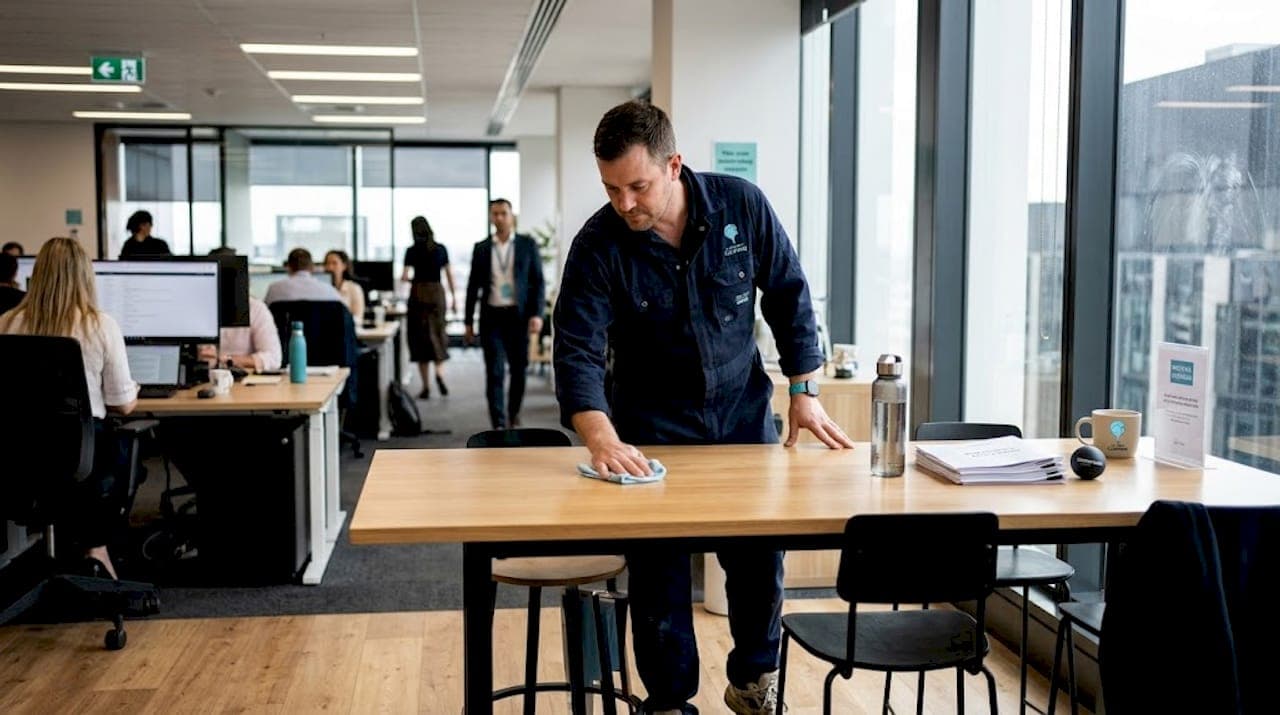
TL;DR:
- Proper hygienic cleaning involves both removing dirt and actively reducing harmful microbes.
- Following the correct sequence of cleaning steps ensures effective sanitation and regulatory compliance.
- Consistent routines, staff training, and documentation are essential for maintaining hygienic workplaces across sectors.
Many Australian business owners assume that a clean-looking workplace is a compliant one. It is not. The gap between cleaning and sanitising is where contamination risks hide, where audit failures happen, and where staff health quietly suffers. Hygienic cleaning standards are not just about appearances. They are about meeting legal obligations, protecting your people, and maintaining the trust of every customer who walks through your door. This article breaks down what hygienic cleaning actually means, how the process works, what standards apply to your sector, and how to build routines that hold up under scrutiny.
Table of Contents
- Understanding hygienic cleaning: Definitions and essentials
- The cleaning and sanitising process: Step-by-step guidance
- Industry-specific standards: How compliance differs by sector
- Applying hygienic cleaning: Practical strategies for Australian workplaces
- Our take: What most business owners miss about hygienic cleaning
- Need reliable hygienic cleaning? See how we support Australian businesses
- Frequently asked questions
Key Takeaways
| Point | Details |
|---|---|
| Cleaning vs sanitising | Hygienic cleaning requires removing dirt and then sanitising surfaces to destroy germs and meet compliance. |
| Sector-specific standards | Different industries must follow distinct Australian standards, like Standard 3.2.2 or AS/NZS 4187, depending on risk. |
| Step-by-step practice | Effective hygienic cleaning means following a set process, using the right products, and routinely monitoring results. |
| Practical workplace routines | Regular staff training and structured routines ensure consistent hygiene and reduce risk in every business. |
| Expert support | Specialist cleaning services help businesses meet compliance effortlessly while protecting health and reputation. |
Understanding hygienic cleaning: Definitions and essentials
Hygienic cleaning is not the same as giving surfaces a quick wipe. According to Food Standards Australia New Zealand guidelines, hygienic cleaning refers to cleaning practices that ensure premises, equipment, and surfaces are maintained in a clean and sanitary condition to prevent contamination and comply with Australian health and safety standards.
This definition carries real weight. It means your cleaning programme must do more than remove visible dirt. It must actively reduce the microbial load on surfaces to a level that is safe for your specific commercial environment.
Here is where many businesses get confused. Cleaning removes physical soil, grease, and residue using detergent and water. Sanitising goes further, using heat or chemical agents to kill or reduce harmful microorganisms to safe levels. One does not replace the other. You must do both, in the right order, to achieve genuine hygiene.
Why does this matter for your business? Consider these key reasons:
- Contamination from improperly cleaned surfaces can lead to illness outbreaks, legal liability, and reputational damage
- Regulatory bodies in Australia conduct inspections and expect documented evidence of hygienic cleaning practices
- Poorly maintained premises can trigger fines, licence suspension, or forced closure
- Staff working in unhygienic environments face higher rates of illness and reduced productivity
"Cleaning removes the dirt. Sanitising removes the risk. Both are non-negotiable in any Australian commercial setting."
Understanding home cleaning best practices can offer useful context, but commercial environments operate under far stricter obligations. For a detailed breakdown of what those obligations look like in practice, the office cleaning standards guide for Australian businesses in 2026 is a strong starting point.
The foundation of hygienic cleaning is understanding that every surface in your workplace carries a risk profile. High-touch zones like door handles, shared equipment, and benchtops demand more frequent and rigorous attention than low-contact areas. Knowing the difference, and acting on it, is what separates compliant businesses from those that are simply hoping for the best.
The cleaning and sanitising process: Step-by-step guidance
Knowing the theory is one thing. Executing it correctly is another. The official cleaning guidelines are clear: cleaning, which involves the physical removal of visible soil using detergent and water, must precede sanitising, which uses heat, chemicals like 100ppm chlorine, or alcohol to reduce microbes to safe levels.
Skipping or reversing these steps is one of the most common mistakes in commercial settings. If you sanitise a surface that still has grease or food residue on it, the sanitiser cannot work effectively. The soil acts as a barrier.
Here is the correct sequence for hygienic cleaning in Australian commercial premises:
- Remove loose debris using a dry cloth, brush, or scraper before applying any liquid
- Apply detergent solution and scrub to lift soil, grease, and organic matter from the surface
- Rinse thoroughly with clean water to remove all detergent residue
- Apply sanitiser at the correct concentration, such as 100ppm chlorine solution, or use hot water at 77°C for at least 30 seconds
- Allow contact time so the sanitiser can work. Do not wipe immediately
- Air dry or use a clean cloth to avoid recontamination from dirty equipment
Pro Tip: Always check the label on your sanitiser for the correct dilution rate and contact time. Using a stronger concentration does not mean better results and can leave harmful chemical residue on food contact surfaces.
Here is a quick comparison of the two most common sanitising methods used in Australian commercial settings:
| Method | Temperature or concentration | Contact time | Best used for |
|---|---|---|---|
| Hot water | 77°C or above | 30 seconds | Equipment, utensils |
| Chlorine solution | 100ppm | 30 seconds | Benchtops, food surfaces |
| Alcohol-based sanitiser | 70% ethanol | 30 seconds | High-touch surfaces |
For practical cleaning strategies that translate across different environments, the principles remain consistent: sequence matters, concentration matters, and contact time matters. If you manage a commercial office, the office cleaning guide provides sector-specific guidance worth reviewing.
Common mistakes to avoid include using the same cloth for cleaning and sanitising, failing to dilute chemicals correctly, and skipping the rinse step between cleaning and sanitising. Each of these shortcuts undermines the entire process.
Industry-specific standards: How compliance differs by sector
Not every business in Australia faces the same cleaning obligations. The tiered standards that apply depend heavily on your sector's risk level. In commercial settings, hygienic cleaning follows tiered standards: Standard 3.2.2 (Food Safety Practices) requires clean and sanitary premises, while higher-risk sectors like healthcare use AS/NZS 4187, NSQHS Standards, and the Spaulding classification for disinfection levels.
Here is how requirements break down across common Australian sectors:
| Sector | Applicable standard | Key requirement |
|---|---|---|
| Food and hospitality | Standard 3.2.2 | Clean and sanitary premises at all times |
| Healthcare and medical | AS/NZS 4187, NSQHS | Spaulding classification for disinfection levels |
| Education and childcare | State-based regulations | Daily sanitising of contact surfaces |
| Retail | General WHS obligations | Regular cleaning of high-touch zones |
| Office environments | WHS Act 2011 | Safe and hygienic work environment |
The Spaulding classification is worth understanding if you operate in or near healthcare settings. It categorises medical items and surfaces into three tiers: critical (items entering sterile tissue, requiring sterilisation), semi-critical (contact with mucous membranes, requiring high-level disinfection), and non-critical (skin contact only, requiring low-level disinfection). This framework shapes every cleaning decision in a clinical environment.
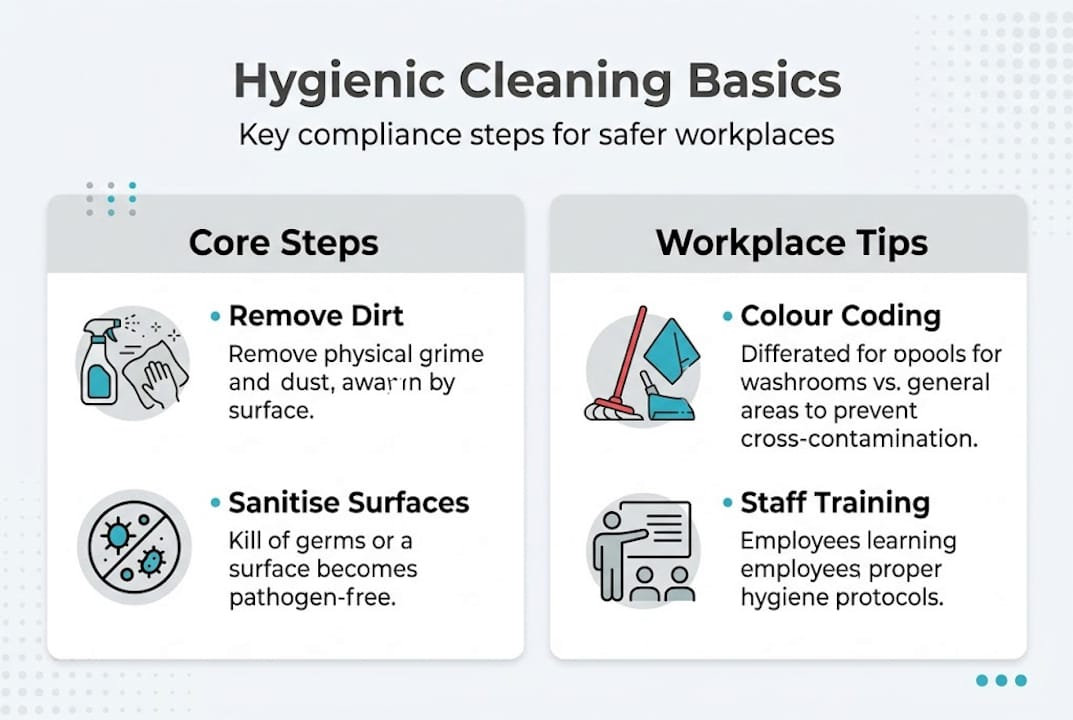
For retail businesses, retail hygiene boosting sales is a real and measurable outcome. Customers notice, and studies consistently show that cleanliness influences purchasing decisions. The office hygiene guide for Australian businesses is equally relevant for any employer managing shared workspaces.
Key differences across sectors include:
- Food premises must maintain written cleaning schedules and make them available for inspection
- Healthcare facilities must document disinfection levels and validate cleaning outcomes
- Education settings must prioritise sanitising of shared items like desks, toys, and bathroom fixtures
- Retail and office environments must address high-touch surfaces daily under general WHS obligations
For a full overview of what cleaning standards compliance looks like across sectors in 2026, that resource covers the regulatory landscape in practical detail.
Applying hygienic cleaning: Practical strategies for Australian workplaces
Understanding standards is only useful when it translates into consistent daily action. Compliant cleaning practices require that premises, equipment, and surfaces are maintained in a clean and sanitary condition as an ongoing commitment, not a one-off effort.
Building a reliable routine starts with frequency. Here is a practical framework:
- Daily tasks: Sanitise all high-touch surfaces including door handles, light switches, shared equipment, and bathroom fixtures. Clean food preparation areas after each use. Empty bins and replace liners.
- Weekly tasks: Deep clean floors, sanitise less-used surfaces, inspect cleaning equipment for wear, and restock consumables like soap and sanitiser.
- Monthly tasks: Review and update your cleaning schedule, inspect hard-to-reach areas, assess chemical stock, and conduct staff refresher training.
Staff training is often the weakest link in workplace hygiene. Your team needs to understand not just what to clean, but why the sequence matters and how to verify that sanitising has been effective. Written procedures, posted near cleaning stations, reduce the chance of shortcuts.
Pro Tip: Introduce a simple sign-off system where staff initial a cleaning log after completing each task. This creates accountability, supports compliance audits, and helps identify gaps in your routine before they become problems.
Preventing cross-contamination is another critical area. Use colour-coded cloths and mops for different zones. Never use bathroom cleaning equipment in food preparation areas. Store cleaning chemicals separately from food and consumables.
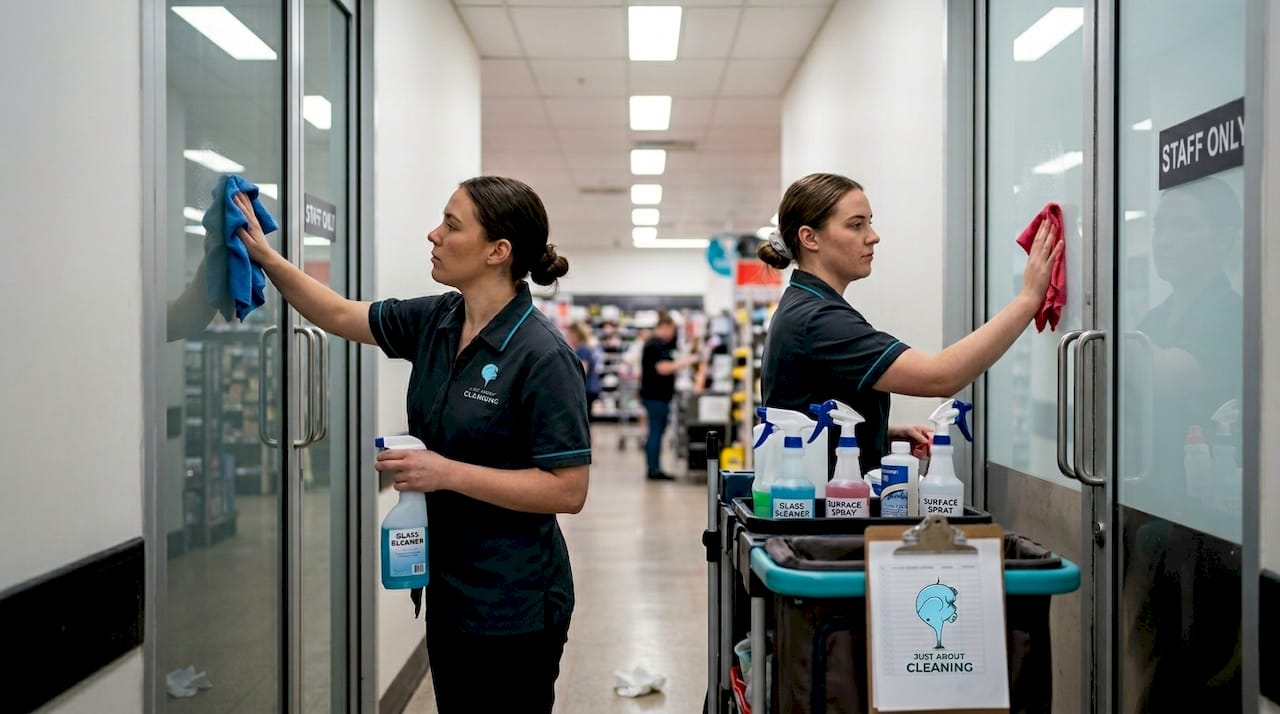
For sector-specific guidance, the education facility protocols resource is particularly thorough. And if you are building the case internally for why this investment matters, routine cleaning benefits for healthier facilities makes the business case clearly. Ensuring your team follows cleaning standards compliance practices protects both your staff and your licence to operate.
Our take: What most business owners miss about hygienic cleaning
After more than 15 years working across Australian commercial sectors, we have seen the same pattern repeat itself. A business invests in cleaning but focuses almost entirely on visible results. Floors shine. Benchtops look spotless. Yet the sanitising step is rushed, underdocumented, or skipped when staff are busy.
This is the gap that costs businesses most. Not the visible dirt, but the invisible risk. Regulators do not just look at how clean your premises appear. They look at your records, your procedures, and your chemical logs. A spotless kitchen with no cleaning schedule on file is still a compliance failure.
The other thing most owners miss is that quick-fix approaches, such as switching products or doing a one-off deep clean before an inspection, rarely satisfy top compliance standards. Auditors are trained to spot reactive cleaning versus embedded routine. The businesses that pass inspections consistently are those that treat hygienic cleaning as a system, not a task. That shift in thinking is what separates genuinely compliant operations from those that are always one audit away from a problem.
Need reliable hygienic cleaning? See how we support Australian businesses
Meeting Australian hygienic cleaning standards takes more than good intentions. It takes trained staff, the right products, documented procedures, and consistent execution across every shift.
At Just About Cleaning Australia, we have spent over 15 years helping businesses across healthcare, retail, education, hospitality, and office environments maintain compliant, hygienic workplaces. Our trained crews follow sector-specific protocols, use eco-friendly products, and provide the documentation your business needs to stay audit-ready. If you are ready to take the pressure off your team and ensure your premises meet every relevant standard, explore our expert hygienic cleaning services and see how we can support your business.
Frequently asked questions
What is the primary difference between cleaning and sanitising?
Cleaning removes visible soil and residue from surfaces, while sanitising uses heat or chemicals to eliminate microorganisms. As cleaning must precede sanitising for best results, skipping either step leaves your premises non-compliant.
Which Australian standards must businesses follow for hygienic cleaning?
Food businesses must follow Standard 3.2.2, while healthcare settings refer to AS/NZS 4187 and NSQHS Standards. Tiered standards apply depending on your sector's risk level, so it is important to identify which framework governs your premises.
Do all commercial premises need sanitising after cleaning?
Yes. Sanitising is essential for all high-touch surfaces in commercial premises to ensure compliance and reduce infection risk, regardless of industry.
How often should hygienic cleaning be performed?
High-traffic and food-handling areas require daily hygiene routines, while lower-risk zones may be addressed weekly. The routine is based on a risk assessment of your specific premises and the compliance requirements of your sector.