
TL;DR:
- Conventional cleaning products harm ecosystems through water pollution and persistent chemicals.
- Verified certifications like GECA and ISO 14001 ensure genuine green cleaning practices.
- Green cleaning may be slightly more expensive upfront but offers health, compliance, and cost benefits over time.
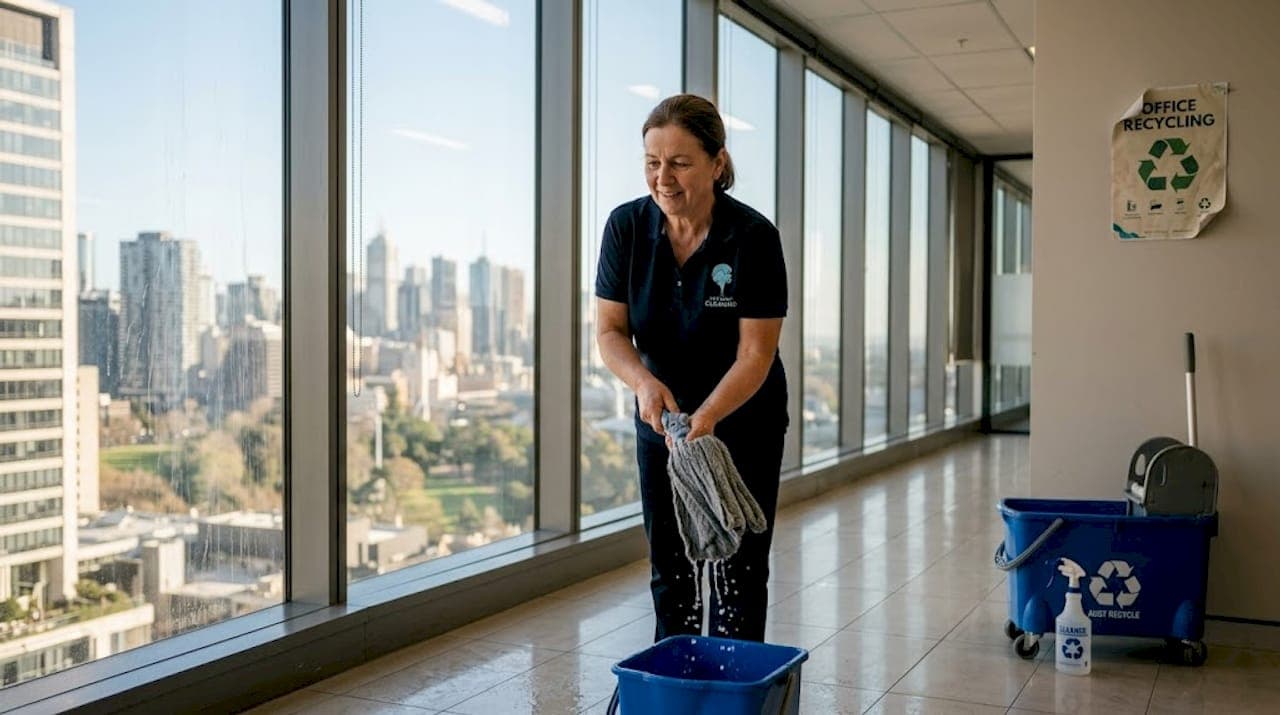
Most facility managers assume that any professional cleaning service keeps a building hygienic without leaving a broader footprint. That assumption is costly. Conventional cleaning products release water pollution and marine harm into Australian waterways every day, threatening both ecosystems and your organisation's compliance standing. For businesses operating under Green Star, NABERS, or ISO 14001 frameworks, the cleaning products used on your premises are not a minor detail. They are a measurable part of your environmental performance. This guide walks you through the real impacts, the meaningful differences between providers, and a practical process for choosing a cleaning service that holds up to scrutiny.
Table of Contents
- How cleaning services affect Australia's environment
- What sets green cleaning services apart
- Compliance, cost and health: Why environmental impact matters for business
- How to choose environmentally responsible cleaning services
- The uncomfortable truth about cleaning and sustainability in Australia
- Ready to make a genuine difference? Partner with experts in green cleaning
- Frequently asked questions
Key Takeaways
| Point | Details |
|---|---|
| Cleaning chemicals pollute | Conventional cleaning products release chemicals that persist in waterways and damage ecosystems. |
| Green services offer proof | Genuinely green cleaning providers hold third-party certifications and use low-impact methods. |
| Compliance boosts health | Following environmental standards in cleaning can improve staff wellbeing and reduce business risk. |
| Upfront cost, long-term gain | Green cleaning may cost more initially, but offers savings through fewer sick days and improved ESG outcomes. |
How cleaning services affect Australia's environment
Traditional cleaning relies on a cocktail of compounds that do not simply vanish after mopping a floor or scrubbing a surface. Phosphates, VOCs, and surfactants from conventional cleaning products enter drains, pass through sewage systems, and reach rivers, wetlands, and coastal marine environments. Some of these compounds resist breakdown for months. The result is an ongoing chemical load that accumulates in sediment and aquatic food chains.
Phosphates trigger algal blooms that deplete oxygen in rivers and estuaries, killing fish and invertebrates. Volatile organic compounds (VOCs) evaporate into indoor and outdoor air, contributing to poor air quality. Non-biodegradable surfactants coat water surfaces, disrupting the gas exchange that aquatic life depends on. These are not isolated incidents. They are the routine output of facilities that have not reviewed their cleaning specifications.
You can see the scale of this issue in water quality data. Sewage effluent from cleaning chemicals pushes river total nitrogen (TN) and salinity well above guideline levels, stressing freshwater ecosystems across Australia's south-east.
River TN levels downstream of urban discharge points regularly spike beyond safe thresholds, a direct consequence of chemical-laden effluent from commercial and residential cleaning at scale. When those levels rise, aquatic biodiversity shrinks and remediation costs fall on the public.
Learn more about eco-friendly cleaning facts to understand how these inputs compare across industry sectors.
Common pollutants from conventional cleaning and their impacts:
| Chemical type | Source | Environmental effect |
|---|---|---|
| Phosphates | Dishwashing and floor cleaners | Algal blooms, oxygen depletion |
| VOCs | Solvents, aerosol sprays | Air quality deterioration |
| Non-biodegradable surfactants | Degreasers, disinfectants | Surface film, aquatic toxicity |
| Chlorine compounds | Sanitisers, bleach | Aquatic organism harm, disinfection byproducts |
The combined effect is significant. Facilities that run large-scale cleaning programmes without reviewing chemical inputs are contributing to measurable ecological damage, whether or not they intend to.
What sets green cleaning services apart
Understanding the harms makes it easier to see what a genuinely green cleaning service actually looks like in practice. The difference is not simply about swapping one bottle for another labelled "natural."
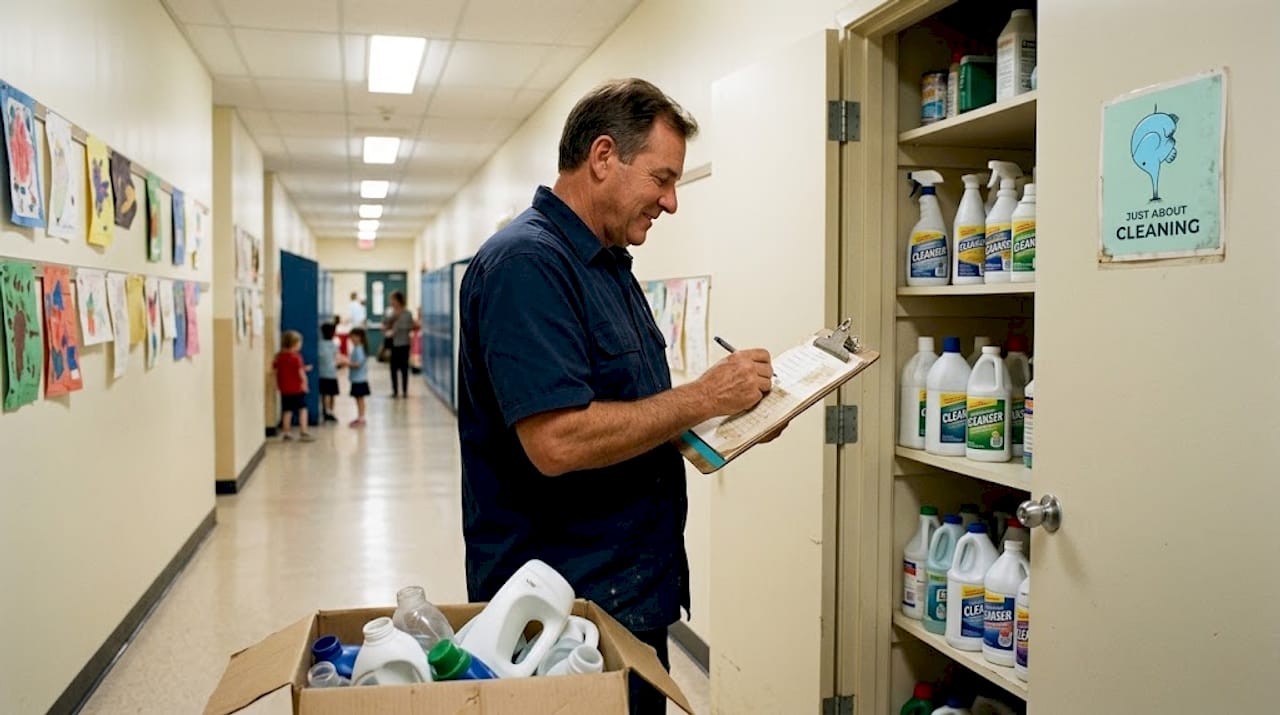
GECA-certified products meet strict criteria including low VOC content, zero phosphates, and full biodegradability. Good Environmental Choice Australia (GECA) is an independent, third-party certification body. ISO 14001 is an international environmental management standard that governs how an organisation controls its environmental impact at a systems level. NABERS (National Australian Built Environment Rating System) and Green Star measure a building's overall environmental performance, including inputs like cleaning chemicals and waste.
Green cleaning services also differ in their methods, not just their products. Microfibre cleaning removes 99% of particles from surfaces without any chemical at all. On-site ozone generation neutralises bacteria and odours using only oxygen and water. Plant-based concentrated formulas reduce packaging waste and transport emissions. These methods deliver measurable results while protecting indoor air quality for your staff.
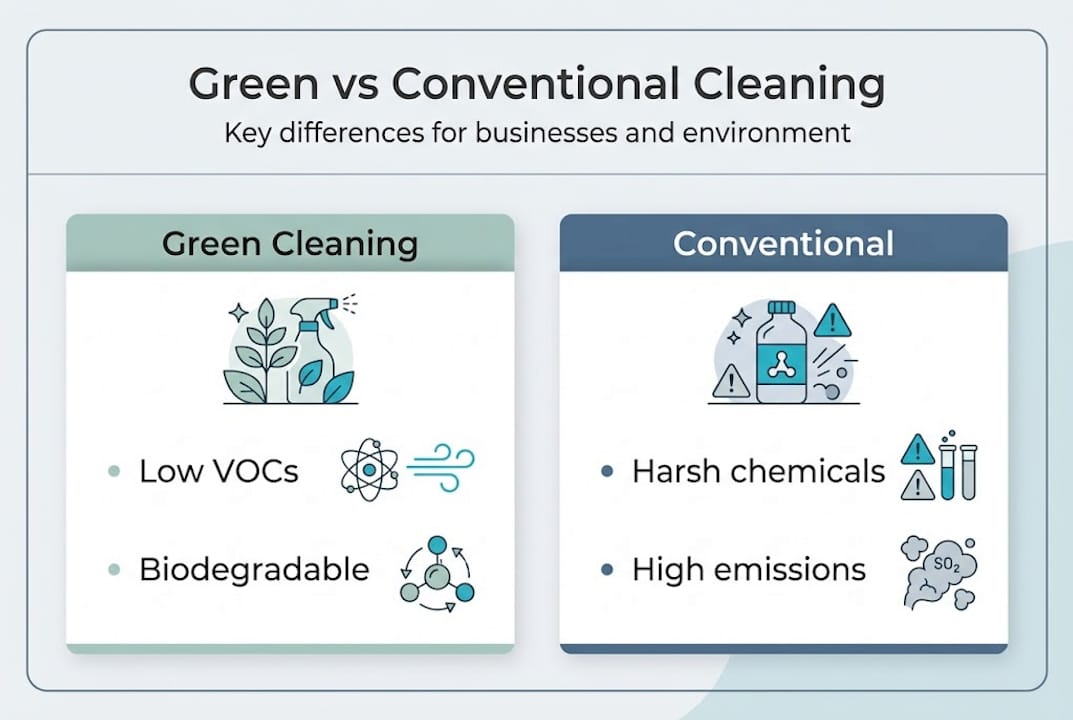
Green vs conventional cleaning at a glance:
| Factor | Green cleaning | Conventional cleaning |
|---|---|---|
| VOC content | Low to zero | Often high |
| Biodegradability | Full within 28 days | Partial or none |
| Certifications | GECA, ISO 14001, NABERS | Usually none |
| Health outcomes | Fewer respiratory complaints | Higher incidence of irritants |
| Upfront product cost | 15-25% higher | Lower |
Pro Tip: Do not accept "eco-friendly" or "green" branding at face value. Ask your provider to show you their GECA certificate number or ISO 14001 registration. Both are publicly verifiable. If they cannot produce these, their claims are marketing language, not a verified standard.
Reviewing your provider's approach against sustainable cleaning practices gives you a practical benchmark. You can also compare providers against the framework outlined in green cleaning practices to assess alignment with your ESG commitments.
Compliance, cost and health: Why environmental impact matters for business
With clear differences established, let's explore the concrete business reasons for going green. Compliance, health, and financial outcomes are all connected to the cleaning choices you make.
For Australian facilities, key compliance frameworks include Green Star (managed by the Green Building Council of Australia), NABERS (managed by NSW Department of Planning), and ISO 14001 (international, audited locally). Green cleaning is central to achieving and maintaining Green Star and NABERS ratings. Without verified green inputs, your facility cannot credibly claim these ratings, exposing you to audit risk and reputational damage.
Business case considerations for green cleaning:
- Regulatory compliance: Cleaning inputs are audited as part of Green Star and NABERS assessments
- Staff health: 30% fewer sick days have been linked to green cleaning methods, reducing absenteeism costs
- ESG reporting: Verified green cleaning contributes directly to environmental reporting metrics
- Waste reduction: Concentrated formulas and reusable equipment cut consumable waste
- Brand value: Clients and tenants increasingly factor environmental standards into procurement decisions
The cost picture is often misread. Green products may carry a 15-25% higher unit price, but the return on that investment comes through reduced sick leave, lower waste disposal costs, and avoided compliance penalties. When you factor in the full cost of a sick day, including lost productivity and temporary cover, the maths shifts considerably.
Pro Tip: Ask any prospective provider to show you their current certifications, not just a brochure. Greenwashing is common in the cleaning sector. If the certification cannot be verified through the issuing body's website, treat it as unverified.
For a clear breakdown of what these standards require, review cleaning standards explained for Australian businesses in 2026.
How to choose environmentally responsible cleaning services
Now, let's equip you with a clear process for evaluating and selecting providers based on genuine environmental performance.
Step-by-step selection framework:
- Assess your compliance obligations. Identify which frameworks apply to your facility. Green Star, NABERS, ISO 14001, and sector-specific standards each have different requirements for cleaning inputs.
- Request verified certifications. Ask for GECA certificate numbers, ISO 14001 registration details, and any NABERS documentation. Cross-check these against the issuing body's public register.
- Compare cleaning methods. Look beyond products. Ask whether the provider uses microfibre systems, HEPA-filter vacuums, ozone-based sanitation, or concentrated plant-based formulas.
- Check waste reduction initiatives. Does the provider use reusable containers? Do they participate in packaging take-back schemes? How do they manage chemical disposal?
- Set performance monitoring terms. Include environmental KPIs in your service agreement. Request quarterly reporting on product usage, waste generated, and any incidents.
Best practice methods to look for:
- Microfibre cloths and mop heads (reusable, chemical-free cleaning)
- HEPA-filter vacuums (capture fine particles without recirculating them)
- On-site ozone generation for sanitising (no chemical residue)
- Concentrated plant-based formulas (reduced packaging and transport footprint)
- Closed-loop chemical dispensing systems (precise dosing, less waste)
Greenwashing risk is high in the cleaning industry; third-party certifications and verifiable supply chains are the most reliable safeguards. In high-humidity environments like Queensland, also confirm that your provider has mould-specific solutions that meet local conditions without defaulting to harsh biocides.
The types of cleaning services available vary widely, and matching the right method to your facility type is as important as selecting the right products. On-site ozone and concentrated plant-based cleaners are currently among the most effective and low-impact options available to Australian facility managers.
The uncomfortable truth about cleaning and sustainability in Australia
Most guides on green cleaning stop at certifications. That is where the real work begins, not where it ends.
We have seen facilities proudly display their Green Star ratings while their cleaning contractors quietly substitute certified products with cheaper alternatives when stock runs low. No one notices until an audit. Certifications matter, but they are a starting point, not a guarantee of ongoing performance.
Supply chains for cleaning chemicals shift. Products get reformulated. Standards are updated. A provider who was genuinely compliant in 2024 may not be compliant in 2026 if they have not reviewed their product list against current GECA criteria. The decision-makers who focus entirely on the certificate at sign-up, and never revisit the question, are the ones most exposed.
The cultural shift we believe Australian businesses need is to treat sustainability in cleaning as a continuous partnership rather than a procurement checkbox. That means scheduled reviews, open dialogue with your provider, and a willingness to ask hard questions. View it as sustainable cleaning practices in motion, not a policy gathering dust.
Ready to make a genuine difference? Partner with experts in green cleaning
Choosing a cleaning service that genuinely protects Australia's environment and supports your compliance goals is not straightforward. It takes verified expertise, up-to-date knowledge of certification standards, and a provider who treats environmental accountability as an ongoing commitment.
At Just About Cleaning, we bring over 15 years of experience in delivering environmentally responsible cleaning solutions across commercial, healthcare, education, and industrial sectors. Our teams use GECA-aligned products, verified methods, and structured reporting so you always know what is being used on your premises and why. Get in touch to discuss a tailored green cleaning programme that fits your facility's specific compliance requirements and environmental goals.
Frequently asked questions
What chemicals in cleaning services are most harmful to the environment?
Phosphates, VOCs, and surfactants are the primary pollutants from conventional cleaning products, with each compound contributing to waterway contamination and harm to marine life in distinct ways.
How can I tell if a cleaning service is genuinely environmentally friendly?
Request the provider's GECA certificate number or ISO 14001 registration and verify it directly through the issuing body's register. Verified certifications like GECA confirm that a product or provider meets independently audited environmental standards, unlike self-applied green branding.
Is green cleaning more expensive for businesses?
Green products typically cost 15-25% more upfront, but facilities commonly see this offset through 30% fewer staff sick days and reductions in waste disposal costs over time.
What Australian laws or standards apply to green cleaning?
GECA, ISO 14001, Green Star, and NABERS are the key frameworks setting requirements for environmentally responsible cleaning in Australian commercial and public facilities, each covering different aspects of product performance and building-level environmental management.
Recommended
- Eco-friendly cleaning for Australian businesses: key facts
- Green cleaning practices: 30% fewer sick days explained
- Why trained cleaners matter: boost health and efficiency
- How cleaning standards boost compliance and safety: 34% fewer infections
- How carpet cleaning improves health and indoor air quality