
TL;DR:
- A cleaning audit is a systematic, documented assessment that measures how well cleaning programs meet sector-specific standards, unlike visual inspections. Such audits help ensure regulatory compliance, reduce risks, improve workplace health, and maintain reputation by focusing on high-priority zones. Implementing effective audits involves careful planning, tailored checklists, staff training, ongoing re-evaluation, and fostering a culture of continuous improvement.
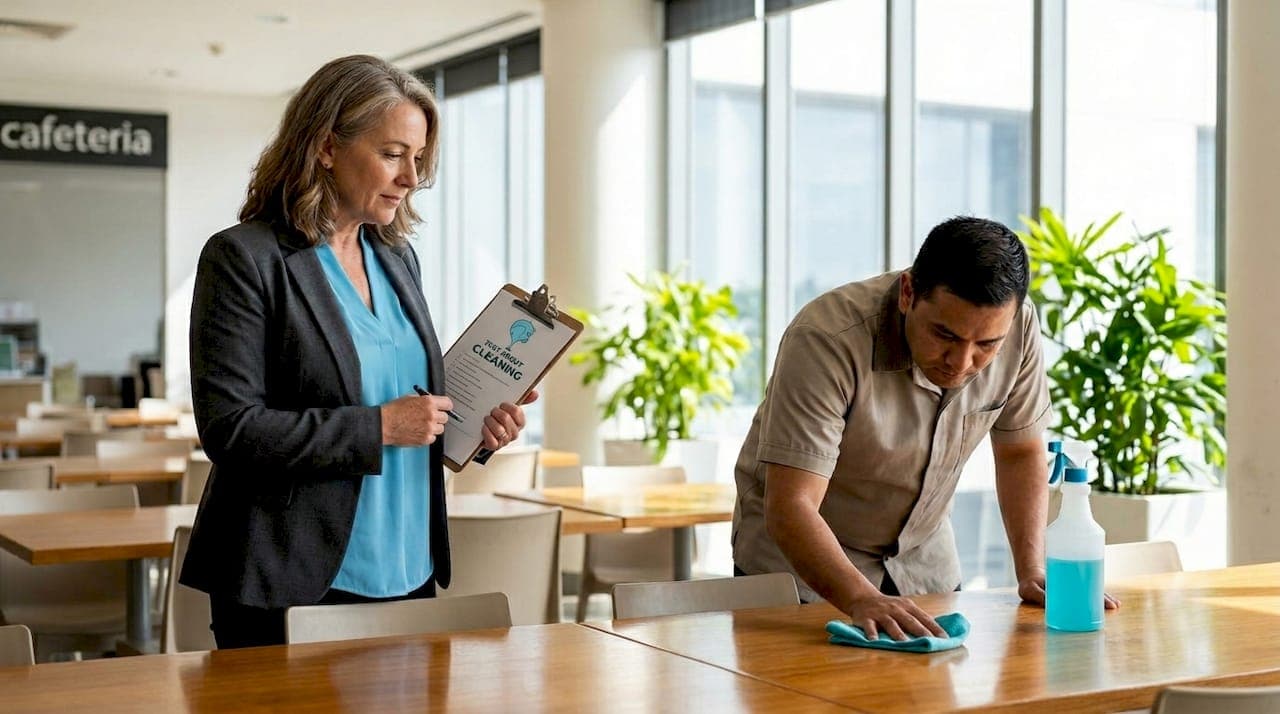
Many facility managers assume a quick walk-through is enough to confirm their premises are clean and compliant. It isn't. A visual inspection misses the bacteria multiplying on a door handle, the chemical residue left on a food prep surface, or the documentation gap that could expose your business to a regulator's scrutiny. A structured cleaning audit is a fundamentally different process, and understanding how it works can protect your people, your reputation, and your bottom line.
Table of Contents
- What are cleaning audits and why do they matter?
- Key components of a robust cleaning audit
- Common mistakes and pitfalls in cleaning audits
- How to implement an effective cleaning audit for your facility
- The real secret to audit-driven improvement
- Partner with cleaning audit experts for lasting results
- Frequently asked questions
Key Takeaways
| Point | Details |
|---|---|
| Prioritise high-risk areas | Focusing audits on high-touch zones dramatically reduces occupant risk and improves program quality. |
| Go beyond templates | Combine standard checklists with sector-specific standards for more accurate, actionable audits. |
| Turn audits into action | Use audit outcomes to upgrade cleaning methods, staff training, and organisational culture. |
| Partner for compliance | Professional providers bring unbiased, expert insight to ensure your facility exceeds legal and hygiene standards. |
What are cleaning audits and why do they matter?
A cleaning audit is a systematic, documented assessment of how well your cleaning programme is performing against defined standards. It is not the same as a supervisor glancing around to see whether the floors look tidy. Audits use checklists, measurable criteria, and recorded findings to produce evidence that cleaning tasks have been carried out to the required level. Think of it as quality assurance for hygiene.
This distinction matters enormously in commercial environments. A general cleaning routine tells you what was done. An audit tells you whether what was done was effective, consistent, and compliant with the standards that apply to your sector. Those standards vary: a childcare centre faces different regulatory benchmarks than a warehouse, and both differ from a medical facility.
The practical benefits of regular audits include:
- Legal and regulatory compliance: Many Australian industries operate under specific hygiene legislation. Documented audit records provide evidence of due diligence if an incident occurs or an inspection is conducted.
- Risk reduction: Identifying and correcting deficiencies before they cause illness, injury, or complaints reduces liability.
- Healthier workplaces: Consistent hygiene directly reduces staff absenteeism and creates a safer environment for employees and visitors.
- Reputation management: Clients, patients, and customers notice when a facility is genuinely clean. Audits keep standards from slipping quietly over time.
- Contractor accountability: If you outsource cleaning, audits give you objective data to hold your provider to their service agreement.
Audits also determine where to focus attention. High-risk and high-touch areas are prioritised in audits because they are direct indicators of programme quality and are where deficiencies generate immediate occupant risk and complaints. This drives checklist design and sampling decisions.
High-priority zones in any audit: Washrooms, kitchen and food preparation areas, reception desks, lift buttons, door handles, and shared equipment surfaces must be assessed first. Deficiencies in these zones carry the highest risk of disease transmission and the most immediate impact on occupant perception.
If your business has retail spaces, understanding retail cleaning hygiene standards is a sensible first step. For a broader view of regulatory requirements, our guide on cleaning standards and safety provides a solid foundation.
Key components of a robust cleaning audit
With the need for systematic auditing clear, the next step is understanding what actually goes into a thorough cleaning audit. A well-structured audit has three core components: a detailed checklist, a sequenced process, and a clear reporting mechanism.
The audit checklist defines what gets assessed, how it is measured, and what an acceptable outcome looks like. Generic checklists are a starting point, but they must be adapted to your facility type, occupancy levels, and the relevant sector standards. A checklist for a commercial office will look different from one used in a hospital corridor.
Here is a sample structure for a risk-based cleaning audit checklist:
| Audit zone | Evaluation criteria | Risk level | Frequency |
|---|---|---|---|
| Washrooms and amenities | Surface cleanliness, supply levels, odour control, touch-point disinfection | High | Daily or after each shift |
| Kitchen and breakrooms | Bench surfaces, appliance hygiene, waste management, floor condition | High | Daily |
| Reception and entry | Floor cleanliness, glass surfaces, seating, touch points | Medium | Daily |
| Open plan offices | Desks, keyboards, shared equipment, bins | Medium | 3 times per week |
| Storage and plant rooms | Floor cleanliness, spill containment, equipment storage | Low | Weekly |
The audit process itself should follow a logical sequence to ensure nothing is missed:
- Preparation: Review previous audit reports, confirm which standards apply, and brief the auditor or audit team.
- Site walkthrough: Inspect each zone against checklist criteria. Use photographs and notes to document findings objectively.
- Sampling: In high-risk areas, supplement visual checks with swab testing or ATP (adenosine triphosphate) testing, a method that detects biological residue invisible to the naked eye.
- Scoring: Assign a score or rating to each area based on how well it meets the defined standard. Many frameworks use a percentage-based pass or fail threshold.
- Reporting: Compile findings into a written report with clear corrective actions, responsible parties, and completion deadlines.
- Follow-up: Re-inspect corrective action areas at the next scheduled audit or sooner for critical deficiencies.
Understanding how office cleaning standards are structured will help you align your checklist to recognised benchmarks.
Pro Tip: Do not download a generic template and apply it without modification. Tailor your audit checklist to the specific risks of your sector. A gym, a childcare centre, and a strata property each have distinct hygiene obligations. Starting with sector-specific guidance, rather than a one-size-fits-all document, will produce audit results that are actually meaningful.

Common mistakes and pitfalls in cleaning audits
Understanding a robust framework is only part of the solution. It is just as critical to avoid common mistakes that can render even the best audits ineffective. In our experience working across commercial facilities in Australia, these are the errors that appear most often.
- Relying solely on visual checks: If an area looks clean, auditors sometimes skip the detailed assessment. Pathogens and chemical residues are not visible to the eye, and a surface that appears spotless may still fail a hygiene test.
- Using outdated or generic checklists: A checklist developed for a different sector or based on outdated standards will not capture the risks specific to your facility.
- Infrequent audits: Auditing once a quarter in a high-traffic, high-risk environment is not sufficient. Deficiencies can develop and compound between assessments.
- No corrective action tracking: Identifying a problem without recording the corrective action and verifying its completion makes the audit a paper exercise, not a quality improvement tool.
- Auditor bias: Internal auditors who manage the cleaning team may unconsciously rate performance more favourably. External auditors or rotating auditors reduce this risk.
- Ignoring occupant feedback: Complaints and concerns from staff and visitors are a valuable data source. Audits that ignore this feedback miss real-world evidence of cleaning failures.
"Facility managers should triangulate audit criteria with recognised standards and, where needed, use third-party or sector-specific guidance rather than one provider's checklist alone. Some templates overemphasise generic criteria or broad assertions without sector-validated benchmarks."
This point cannot be overstated. A checklist that has not been validated against an industry standard offers limited protection if your facility is subject to regulatory inspection. Cross-referencing your audit criteria with recognised Australian standards and sector guidance is not optional; it is a professional obligation for facilities that carry genuine risk.
The area of cleaning compliance value explores this intersection of standards and commercial outcomes in greater depth.
Pro Tip: Before your next audit cycle, compare your current checklist against at least two external references, one from your industry regulator and one from a recognised facility management body. If your checklist does not reflect their language and risk categories, it needs revision before it can be considered reliable.
How to implement an effective cleaning audit for your facility
Avoiding common pitfalls clears the way to implementing a truly effective audit process. Here is how to do it in practice, from initial planning through to continuous improvement.
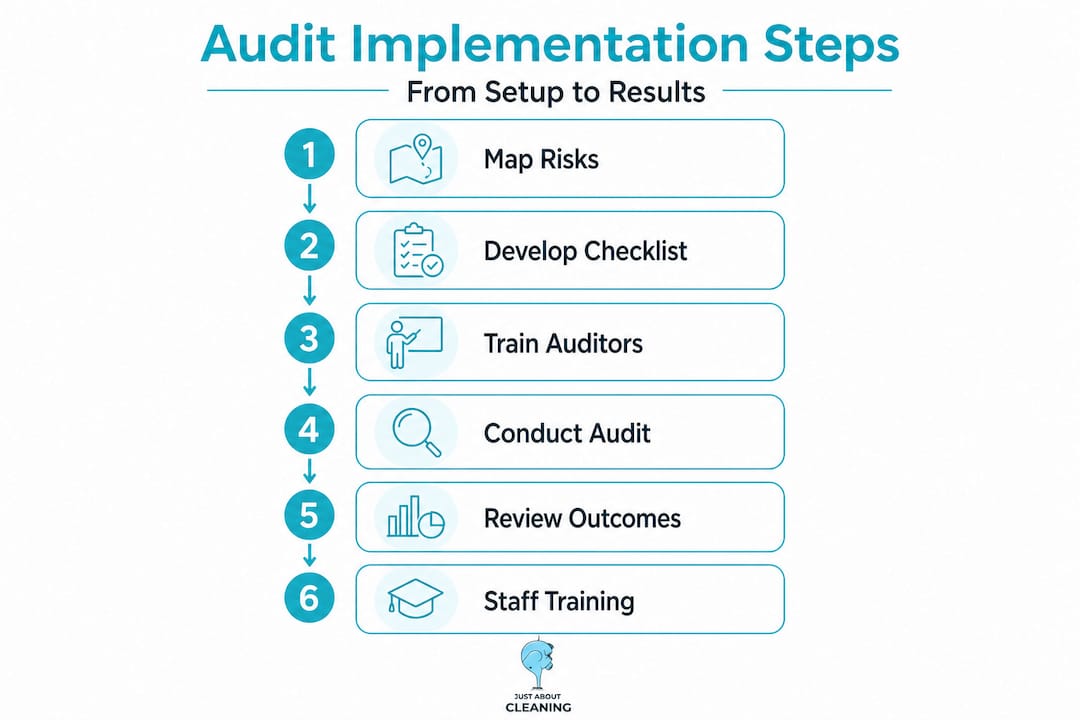
- Define your scope and objectives: Identify which areas of your facility are in scope, what standards apply, and what outcomes you want from the audit programme. Is the primary goal regulatory compliance, contractor accountability, or continuous quality improvement? Knowing this shapes every other decision.
- Map your risk zones: Walk your facility and categorise every zone by risk level. High-traffic areas and those involving food, bodily fluids, or vulnerable populations are automatically high risk. Assign audit frequency based on this mapping.
- Select or develop your checklist: Use sector-specific templates as a starting point and adapt them to your facility. Ensure each checklist item is measurable and unambiguous.
- Train your auditors: Whether auditing is done internally or by a third party, the person conducting the audit must understand the criteria, know how to document findings objectively, and be familiar with the cleaning standards that apply.
- Conduct the audit and document findings: Complete the walkthrough, record scores, take photographic evidence, and note any immediate risks that require urgent attention.
- Communicate results and assign actions: Share the audit report with your cleaning provider and relevant internal stakeholders. Every finding must have a named responsible party and a deadline.
- Track corrective actions and re-audit: Confirm that corrective actions have been completed. High-risk deficiencies should be re-audited within days, not weeks.
A practical timeline for managing ongoing audit improvement looks like this:
| Phase | Task | Timeframe |
|---|---|---|
| Initial setup | Risk mapping, checklist development, auditor training | Weeks 1 to 4 |
| First audit cycle | Full facility audit, findings report, corrective action plan | Month 2 |
| Corrective action review | Verify completion of actions from first audit | Month 3 |
| Ongoing audits | High-risk zones monthly, medium-risk zones quarterly | Ongoing |
| Annual review | Review checklist against updated standards, assess programme performance | Annually |
High-risk and high-touch areas require the most frequent re-assessment because deficiencies in these zones generate immediate occupant risk. Audit frequency should increase when occupancy rises, after a reported illness, or following a change in cleaning contractors.
Audit outcomes also feed directly into staff training. When audit data consistently shows deficiencies in a particular zone or task, that is a training opportunity, not just a compliance issue. Use the data to refine your cleaning procedures and ensure your team understands not just what to do, but why it matters.
For a detailed overview of the national benchmarks that should inform your audit framework, our article on top cleaning standards compliance is worth reviewing before you finalise your checklist.
The real secret to audit-driven improvement
Here is something most facility managers do not hear often enough: a cleaning audit that generates anxiety and defensiveness is failing at its core purpose. The audit is not a performance review designed to catch people out. It is a diagnostic tool. And like any diagnostic tool, its value depends entirely on what you do with the results.
We have seen facilities that conduct rigorous, well-documented audits every month and make zero lasting improvement. Why? Because the findings go into a report, the report goes into a folder, and the cycle repeats without changing behaviour. The audit becomes a ritual rather than a driver of genuine change.
The facilities that genuinely improve are those where leadership uses audit data as a conversation starter, not a verdict. When senior managers ask questions like "Why did we score poorly in the washrooms again this quarter?" and follow through on the answers, behaviour shifts at every level of the organisation. Cleaners understand that standards are taken seriously. Supervisors know their assessments will be scrutinised. And over time, the culture around cleanliness changes.
High-risk and high-touch zones are where this cultural shift shows up first, because they are where deficiencies are most visible and most consequential. When staff see that problems in these areas are addressed promptly and systematically, they begin to own the standard rather than just comply with it.
The goal is to reach a point where the audit confirms what your team already knows: that standards are consistently met because the organisation is genuinely committed to them, not because an audit is due. That shift from compliance-driven to culture-driven hygiene is where the real gains live. For a closer look at what genuine quality in cleaning looks like, our piece on defining cleaning quality offers a useful framework.
Partner with cleaning audit experts for lasting results
If you're ready to move from reactive cleaning management to a structured, audit-driven approach, working with experienced professionals makes the transition faster and more reliable.
At Just About Cleaning, we bring over 15 years of experience delivering cleaning services and compliance support across Australian commercial, healthcare, education, and industrial sectors. Our team understands the sector-specific standards that matter to your facility and can help you design an audit programme that is practical, thorough, and built to last. From customised checklists to ongoing monitoring, we make it straightforward to maintain the hygiene standards your business depends on. Talk to us about how professional audit support can strengthen your compliance posture and protect your people.
Frequently asked questions
What is included in a typical cleaning audit checklist?
A cleaning audit checklist typically covers high-risk zones and touch points, surface cleanliness, consumable supply levels, chemical usage procedures, and adherence to recognised hygiene standards. Each item should be measurable, not just descriptive.
Why are third-party cleaning audits important?
Third-party audits deliver unbiased evaluation and are harder to influence than internal reviews. Facility managers benefit from triangulating audit criteria with recognised standards, and an external auditor brings the objectivity needed to surface risks that internal teams may overlook.
How often should cleaning audits be performed in commercial spaces?
Frequency depends on facility type and risk profile. High-risk and high-touch areas such as washrooms and food preparation zones require more frequent checks, often daily or weekly, while lower-risk spaces may be assessed monthly or quarterly.
How do cleaning audits help with compliance?
Audits produce documented evidence that cleaning tasks have been completed to the required standard. Facility managers who triangulate criteria with recognised standards build a compliance record that satisfies regulatory requirements and supports due diligence in the event of an investigation or incident.