

TL;DR:
- Genuine green cleaning in Australia emphasizes environmental impact, occupant health, and third-party certification.
- Certified products like GECA have strict limits on VOCs, phosphates, and biodegradability, ensuring effectiveness.
- Businesses see measurable benefits such as fewer sick days and reduced chemical waste through proper implementation.
There is a persistent myth in Australian commercial facilities management: that eco-friendly cleaning products sacrifice effectiveness for environmental credentials. The reality is quite different. Businesses report 30% fewer sick days and a 22% reduction in chemical use after switching to green cleaning programmes. For organisations navigating ESG reporting, Green Star ratings, and staff wellbeing obligations, this is not a minor footnote. This guide clarifies what genuine green cleaning looks like in Australian commercial and institutional settings, covering standards, methods, certifications, real business outcomes, and how to avoid being misled by vague eco-claims.
Table of Contents
- What defines green cleaning in Australian commercial settings?
- Key methods and materials for effective green cleaning
- Certification, compliance, and avoiding greenwashing
- Business outcomes: measurable impacts and typical challenges
- Why green cleaning's real value goes beyond compliance
- Take your green cleaning further with expert support
- Frequently asked questions
Key Takeaways
| Point | Details |
|---|---|
| Certification matters | GECA and ISO 14001 confirm your cleaning is genuinely green and recognised Australia-wide. |
| Health and sustainability benefits | Green cleaning cuts workplace toxins and sick days while supporting your organisation's environmental goals. |
| Smart adoption strategy | Start with high-touch areas, invest in staff training, and phase in green cleaning for lasting impact. |
| Avoid greenwashing | Check for genuine third-party certifications rather than relying on supplier claims alone. |
| Business case | Long-term gains include lower chemical waste, indoor air quality improvements, and higher staff retention. |
What defines green cleaning in Australian commercial settings?
Green cleaning in Australia is not simply about swapping one product for another. It is a structured approach that considers environmental impact, occupant health, and social responsibility across the entire cleaning operation. Understanding what separates genuine green cleaning from marketing spin is the first step for any facilities or operations manager.
In Australia, the primary certification body for cleaning products and services is GECA (Good Environmental Choice Australia). GECA-certified products must meet strict criteria: they limit VOC to 3%, require biodegradable surfactants, and ban phosphates. VOC stands for volatile organic compounds, which are airborne chemicals released by many standard cleaning agents that can irritate airways and contribute to poor indoor air quality. GECA certification is third-party verified, which means it carries far more weight than a supplier's self-claim of being "natural" or "eco-friendly."
Here is a quick comparison of what separates certified green cleaning from conventional approaches:
| Criterion | Conventional cleaning | GECA-certified green cleaning |
|---|---|---|
| VOC content | Often 10-30% | Maximum 3% |
| Surfactants | Petroleum-based | Biodegradable, plant-derived |
| Phosphates | Commonly present | Banned |
| Third-party verification | Rarely | Mandatory |
| Packaging requirements | No standard | Reduced and recyclable |
Beyond product certification, green cleaning also supports compliance with broader building and sustainability frameworks. Programmes such as Green Star, NABERS IE (Indoor Environment), WELL, and LEED all recognise green cleaning practices as contributing factors in their assessment criteria. For property owners and facility managers, this directly connects cleaning choices to asset value and tenancy appeal.
Key characteristics of a genuine green cleaning programme include:
- Low or zero VOC formulations to protect indoor air quality
- Biodegradable ingredients that break down without harming waterways
- No phosphates or chlorine bleach in routine cleaning products
- Concentrated formulations to reduce packaging and transport emissions
- GECA or equivalent third-party certification on all core products
For a broader look at the key facts for eco-friendly cleaning in Australian commercial contexts, the evidence is compelling and growing.
Key methods and materials for effective green cleaning
Knowing what standards apply is one thing. Knowing which products and processes actually deliver results in a busy commercial environment is another. Green cleaning has advanced considerably, and the tools available today are well-suited to high-demand institutional settings.
Plant-based active ingredients form the backbone of most certified green cleaning products. Eucalyptus oil offers natural antimicrobial properties and is effective on grease and biofilm. Tea tree oil provides antifungal and antibacterial action. Hydrogen peroxide at appropriate concentrations disinfects without leaving toxic residues. Enzyme-based cleaners are particularly effective in food service, healthcare, and aged care environments, breaking down organic matter at a molecular level rather than simply masking it.
Equipment choices matter just as much as chemistry. Microfibre cloths reduce chemical use by up to 80% and trap 99% of particles, including bacteria, without requiring harsh detergents. HEPA-filtered vacuums capture fine particulates that standard vacuums recirculate into the air. Concentrated formulations, diluted on-site, dramatically cut plastic waste and storage requirements.
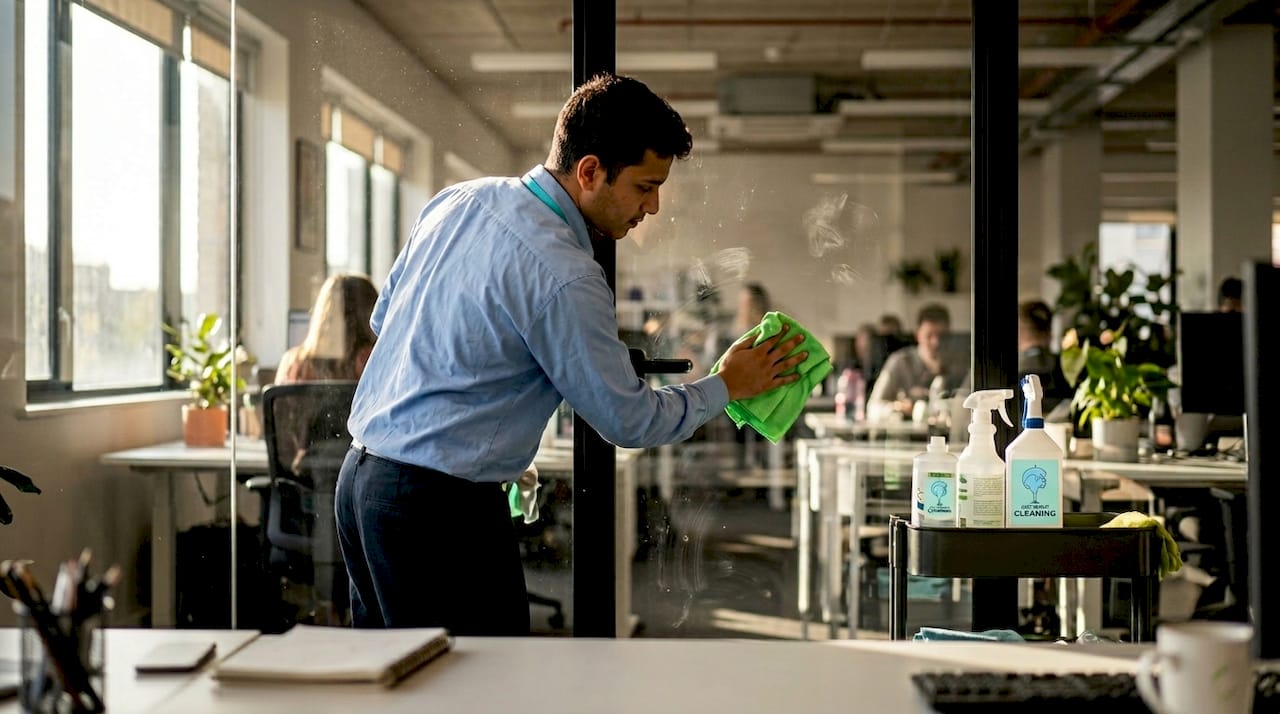
For guidance on selecting commercial eco-friendly cleaners that suit specific facility types, it helps to match the product chemistry to the surface and contamination level.
A practical sequential workflow for green cleaning in commercial spaces:
- Dry remove first using microfibre cloths or HEPA vacuums before applying any product
- Apply concentrated solution at the correct dilution ratio for the surface type
- Allow appropriate dwell time for enzyme or hydrogen peroxide products to activate
- Wipe or extract using colour-coded microfibre cloths to prevent cross-contamination
- Dispose of or launder cloths according to the facility's waste management protocol
Meeting office cleaning standards in Australian workplaces requires this kind of structured approach, not just product substitution.
Pro Tip: The most common reason green cleaning underperforms is inadequate staff training, not product quality. Investing in proper technique training for your cleaning team unlocks the full potential of these methods and prevents costly errors like incorrect dilution ratios.
Certification, compliance, and avoiding greenwashing
Greenwashing is a real and growing problem in the Australian cleaning industry. Suppliers routinely use terms like "natural," "plant-based," or "eco-conscious" without any independent verification. For organisations with genuine sustainability commitments, this creates both reputational and compliance risk.
The clearest protection is requiring documented certification. Only GECA and ISO 14001 offer robust third-party green cleaning certification for Australian commercial settings. ISO 14001 is an international standard for environmental management systems, applicable to the cleaning company itself rather than individual products. Together, these two frameworks cover both product-level and organisational-level environmental performance.
Property and facilities managers should also understand how green cleaning aligns with Green Star, NABERS IE, WELL, and LEED certifications. Each of these frameworks awards credits or points for documented green cleaning practices, which can directly influence a building's rating and, consequently, its market value and lease appeal.
"A third-party audit is the only real proof of green cleaning credentials. Self-declarations without independent verification are marketing, not compliance."
When evaluating a cleaning provider or product supplier, use this checklist:
- GECA certification number visible on product or service documentation
- ISO 14001 certificate for the cleaning company, current and verifiable
- Safety Data Sheets (SDS) confirming VOC content and ingredient disclosure
- Phosphate-free and biodegradable confirmation in writing
- Waste management and packaging reduction policy documented
- Training records for cleaning staff on green protocols
For organisations assessing the full range of commercial cleaning service types available in Australia, understanding these credentials helps narrow the field to providers who can genuinely support your sustainability reporting. Reviewing social and environmental credentials as part of supplier assessment is increasingly standard practice in procurement.
Business outcomes: measurable impacts and typical challenges
The business case for green cleaning is no longer theoretical. Australian organisations that have made the switch are reporting concrete, measurable results across health, operations, and compliance.
On the health side, the data is striking. Businesses report 30% fewer sick days, a 22% reduction in chemical use, and 30% less chemical waste within 3 years of adopting certified green cleaning programmes. Reduced airborne VOCs directly correlate with fewer respiratory complaints, headaches, and skin irritation among staff. In environments like schools, childcare centres, and healthcare facilities, this is particularly significant.
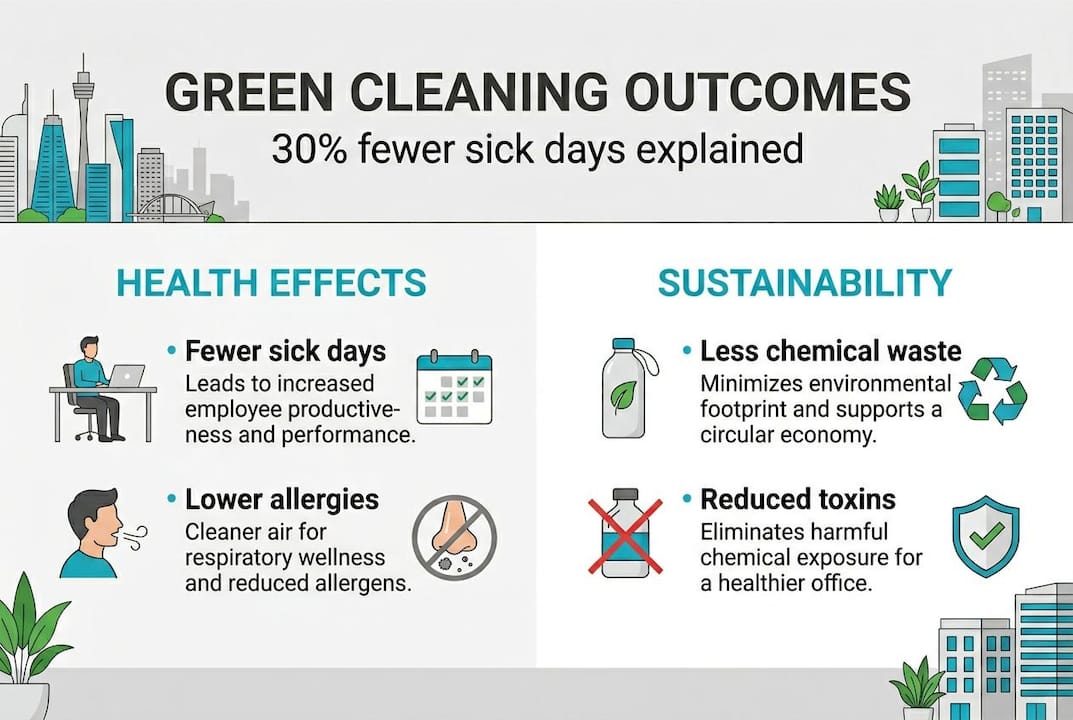
| Outcome metric | Conventional cleaning | Green cleaning (3-year average) |
|---|---|---|
| Staff sick days | Baseline | 30% fewer |
| Chemical inventory volume | Baseline | 22% reduction |
| Chemical waste generated | Baseline | 30% less |
| Indoor air quality complaints | Higher | Significantly lower |
Operationally, concentrated product formats reduce storage space, procurement complexity, and packaging waste. Many organisations find their overall cleaning supply costs stabilise or decrease once the transition period passes.
Common challenges organisations face when switching:
- Higher upfront product costs compared to bulk conventional chemicals
- Staff resistance or retraining requirements when workflows change
- Adapting protocols for high-traffic or high-contamination zones such as loading docks or commercial kitchens
- Supplier verification taking more time than simply reordering existing products
A phased adoption model works best. Start in lower-risk, high-visibility areas such as reception, meeting rooms, and office floors. Measure outcomes, gather staff feedback, and refine the approach before rolling out to more demanding environments. The value of trained cleaners for green cleaning cannot be overstated here. Proper technique is what converts product quality into measurable outcomes.
For further detail on green cleaning supplies suited to Australian commercial environments, there are now well-established guides covering product selection by facility type.
Pro Tip: Begin your green cleaning rollout in high-touch, high-visibility areas like reception desks, lift buttons, and meeting room surfaces. These zones deliver the fastest measurable health and hygiene improvements, making it easier to build internal support for a wider programme.
Why green cleaning's real value goes beyond compliance
Certifications and compliance metrics are important. But in our experience working with Australian organisations across healthcare, education, and commercial property, the most significant benefits of green cleaning rarely appear in a compliance report.
The organisations that treat green cleaning as a cultural commitment rather than a box-ticking exercise consistently outperform those that adopt it purely for certification points. Staff notice when their workplace invests in their health. Prospective employees, particularly younger professionals, actively look for employers whose values align with their own. A genuinely green workplace signals something about how an organisation treats people, not just how it manages its environmental footprint.
Clients and tenants notice too. In competitive commercial property markets, a documented green cleaning programme contributes to a building's story and its appeal. The facts about eco benefits are clear, but the reputational and cultural value is harder to quantify and arguably more durable. Compliance gets you in the door. Values keep you there. The organisations leading on green cleaning in Australia are not doing it because a standard requires it. They are doing it because it reflects what they stand for.
Take your green cleaning further with expert support
If your organisation is ready to move from intention to action on green cleaning, having the right partner makes the difference between a smooth transition and a frustrating one. Understanding certifications, selecting the right products, training staff, and maintaining compliance across multiple sites is a significant undertaking.
Just About Cleaning brings over 15 years of experience supporting Australian businesses across commercial, healthcare, education, and institutional environments. Our trained crews operate with GECA-aligned products and documented green protocols, supporting your ESG reporting and building certification goals. Whether you need a full green cleaning audit, a phased transition plan, or ongoing verified green cleaning services, we can tailor a solution to your facility's specific requirements. Reach out to our team to discuss how we can support your sustainability commitments.
Frequently asked questions
Which green cleaning standards should Australian companies require?
Australian companies should require GECA certification or ISO 14001 for genuine green cleaning compliance in commercial settings. These are the only frameworks offering robust, independent third-party verification.
How do green cleaning practices affect indoor air quality?
Green cleaning reduces indoor toxins significantly by using low-VOC chemicals and biodegradable formulations, improving air quality compared to conventional products. GECA-certified products cap VOC content at 3%, well below standard cleaning agents.
What is the typical return on investment for switching to green cleaning?
Businesses report 30% fewer sick days, a 22% reduction in chemical use, and 30% less chemical waste over three years. These outcomes translate directly to reduced absenteeism costs and lower procurement spend.
Are green cleaning products effective for heavy-duty disinfecting?
New enzyme-based and hydrogen peroxide cleaners now match traditional disinfectants for most commercial needs, though extreme contamination cases may require blended approaches approved under the relevant health standards.
What is the biggest challenge for organisations adopting green cleaning?
Upfront costs and dedicated staff training requirements are the primary initial hurdles, but a phased adoption model delivers long-term savings and supports Green Star and NABERS compliance points over time.