
TL;DR:
- Cleaning directly impacts legal compliance, tenant satisfaction, and long-term property value.
- Effective management requires clear expectations, thorough documentation, and regular inspections.
- Proactive cleaning enhances asset longevity, reduces disputes, and attracts quality tenants.
Property management involves far more than collecting rent and handling maintenance requests. Cleaning is one of the most underestimated responsibilities in the industry, yet it directly shapes compliance outcomes, tenant satisfaction, and the long-term value of your asset. Get it wrong and you face disputes, legal exposure, and costly repairs. Get it right and you protect your investment while building a reputation that attracts quality tenants. This guide unpacks the legal, operational, and practical dimensions of cleaning in Australian property management, so you can move from reactive fixes to a genuinely proactive approach.
Table of Contents
- Why cleaning matters in property management
- Legal obligations and compliance: What the law expects
- Operational challenges and overlooked risk areas
- Building value: The link between cleanliness, tenant satisfaction, and property reputation
- Our perspective: What most guides miss about cleaning and property management
- Next steps: Ensure your property is a step above
- Frequently asked questions
Key Takeaways
| Point | Details |
|---|---|
| Legal compliance | Australian law sets clear cleaning expectations for property managers and tenants. |
| Risk reduction | Attention to overlooked cleaning areas can prevent disputes and protect property value. |
| Tenant satisfaction | Consistent cleanliness encourages better tenants and improves long-term returns. |
| Professional edge | Using systematic cleaning strategies can boost your reputation and asset performance. |
Why cleaning matters in property management
Cleaning is rarely the first thing that comes to mind when property managers think about compliance or asset performance. Yet it underpins both. A poorly maintained property creates friction at every stage of the tenancy lifecycle, from initial inspections to end-of-lease disputes.
The relationship between cleaning and legal compliance is more direct than many realise. Residential Tenancies Acts across Australia establish clear obligations: landlords must provide a clean property at the start of a tenancy, and tenants are required to keep and return the property in a reasonably clean condition aligned with community standards. That phrase, "reasonably clean," carries real legal weight and is frequently misunderstood by both parties.
When expectations are not clearly communicated or documented, disputes become almost inevitable. Tenants may believe they have met their obligations while property managers see something entirely different. These disagreements waste time, strain relationships, and can escalate into tribunal hearings that cost everyone involved.
Effective cleaning also plays a direct role in tenant satisfaction. Consider what a prospective tenant notices during an inspection:
- Visible grime, stains, or odours immediately signal neglect
- Clean surfaces, fresh bathrooms, and tidy common areas signal care and quality
- A well-presented property justifies higher rent and attracts more reliable tenants
- Consistent cleanliness reduces the likelihood of complaints during the tenancy
Beyond impressions, there is a practical maintenance argument. Dirt and grime accelerate wear on surfaces, fixtures, and flooring. Regular cleaning is not just cosmetic. It is a form of asset protection.
"Cleanliness directly affects the perceived and actual value of a rental property. Properties that are consistently maintained attract better tenants and suffer fewer costly disputes at the end of a lease."
Understanding how trained cleaners boost efficiency in managed environments helps property managers see why professional involvement often pays for itself. Similarly, the principles behind maintenance cleaning in facilities apply directly to residential properties, where consistent upkeep prevents larger problems down the line.
Legal obligations and compliance: What the law expects
Australian property law is specific about cleaning responsibilities, yet many managers operate with only a vague understanding of what is actually required. This creates unnecessary risk.
Each state and territory has its own Residential Tenancies Act, but the general framework is consistent. Landlords are legally obligated to provide a property that is clean at the commencement of a tenancy. Tenants must maintain that standard and leave the property in a reasonably clean condition when they vacate. Importantly, this does not automatically mean a professional clean is required at the end of a lease.
| Obligation | Landlord | Tenant |
|---|---|---|
| Start of tenancy | Must provide clean property | N/A |
| During tenancy | Maintain structure and fixtures | Keep reasonably clean |
| End of tenancy | Inspect and document | Return to reasonably clean standard |
| Professional clean required | If specified in lease or prior clean was professional | If pets were kept or prior professional clean occurred |
Here is how to manage compliance effectively:
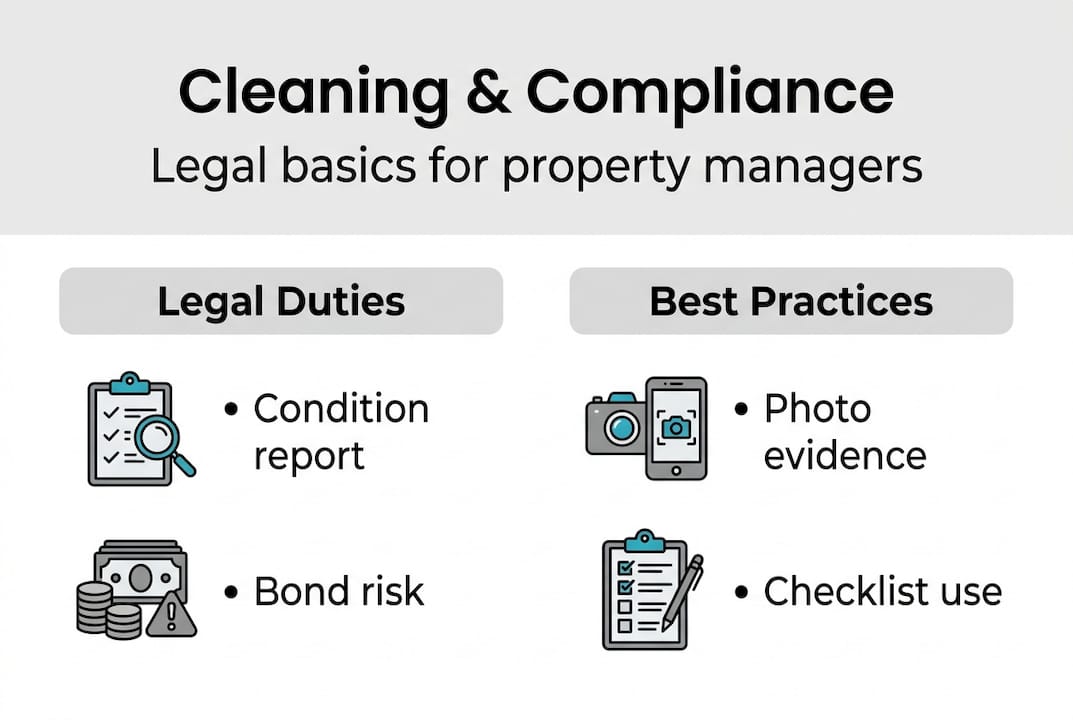
- Complete a thorough condition report at the start of every tenancy, with photos and written notes on cleanliness levels in each room.
- Clarify expectations in writing by including cleaning standards in the lease agreement or a separate schedule.
- Conduct regular inspections during the tenancy to identify and address issues early.
- Document all communication about cleaning concerns, including written notices to tenants.
- Arrange professional cleaning when the situation specifically warrants it, such as after a pet tenancy or when the original handover involved a professional clean.
Following best cleaning practices at the start of each tenancy sets a clear benchmark that protects you legally and makes end-of-lease comparisons straightforward.
Pro Tip: Always attach dated photographs to your condition report. In a tribunal hearing, visual evidence of the property's cleanliness at the start of a tenancy is far more persuasive than written descriptions alone.
Operational challenges and overlooked risk areas
Understanding the law is one thing, but what about putting it into practice? The day-to-day reality of property management involves tight timelines, inconsistent tenant behaviour, and areas that routinely get missed during cleaning.
The most common operational failure is not negligence. It is oversight. Certain areas of a property are consistently undercleaned because they are easy to ignore during a rushed turnover. According to community standards for cleanliness, a reasonably clean property means ovens are free of grease, bathrooms are free of mould, and floors are free of stains. These three areas alone account for the majority of end-of-lease disputes.
| Area | Common issue | Risk if missed |
|---|---|---|
| Oven and rangehood | Grease buildup | Dispute, repair cost |
| Bathroom tiles and grout | Mould growth | Health concern, claim |
| Floors and skirting boards | Stains and dust buildup | Deduction disputes |
| Windows and tracks | Grime and condensation residue | Missed in condition report |
| Exhaust fans | Dust and grease accumulation | Often overlooked entirely |
Operational hurdles that property managers commonly face include:
- Tight turnaround windows between outgoing and incoming tenants, leaving insufficient time for thorough cleaning
- Incomplete handovers where tenants leave behind rubbish, furniture, or unfinished cleaning tasks
- Insufficient guidance given to tenants about what "reasonably clean" actually looks like in practice
- No standard checklist, meaning different staff apply different standards across properties
A detailed kitchen cleaning process is a useful reference point for setting expectations with tenants and contractors alike. For broader guidance, practical cleaning strategies can help you build a consistent framework across your portfolio.
Pro Tip: Develop a property-specific cleaning checklist that tenants receive at the start of their lease and again when they give notice to vacate. This single tool reduces disputes, improves handover quality, and saves hours of follow-up work.
Building value: The link between cleanliness, tenant satisfaction, and property reputation
While avoiding risks is crucial, cleaning also has a powerful upside for growth and asset value. A clean, well-maintained property is not just easier to manage. It is a more valuable asset.
Tenants who live in consistently clean and well-presented properties are more likely to renew their leases, treat the property with care, and recommend the property manager to others. Conversely, a property that shows signs of neglect, even minor ones, signals to tenants that their comfort and health are not a priority. That perception drives turnover.
The financial case for proactive cleaning is straightforward:
- Fewer end-of-lease disputes mean lower tribunal and administrative costs
- Reduced turnover means fewer vacancy periods and lower reletting costs
- Well-maintained surfaces and fixtures last longer, reducing capital expenditure
- Clean properties photograph better, attracting more enquiries and stronger rental applications
- Higher presentation standards support premium rent positioning in competitive markets
Did you know? Properties with consistent maintenance and cleanliness records are often appraised at higher values and attract more competitive offers when sold.
It is worth noting that professional cleaning is not always required at the end of a tenancy, but scheduling periodic professional cleans during a tenancy, particularly for longer-term leases, is a smart investment. It resets the standard, prevents buildup in hard-to-reach areas, and gives you a documented record of the property's condition.
For properties transitioning between seasons or preparing for re-letting, spring cleaning tips offer practical guidance on restoring a property to its best presentation quickly and efficiently.
Pro Tip: Schedule a professional deep clean every 12 to 18 months for long-term tenancies. The cost is modest compared to the repair bills and vacancy losses that accumulate when properties are not regularly reset to a high standard.
Our perspective: What most guides miss about cleaning and property management
Most articles on this topic focus on the minimum. What does the law require? What can you claim from a bond? These are valid questions, but they frame cleaning as a problem to manage rather than an opportunity to leverage.
In our experience, the property managers who consistently outperform their peers are not the ones who know the rules best. They are the ones who treat cleaning as part of their asset strategy. They do not wait for a dispute to reveal a problem. They build deep cleaning compliance into their routine, document everything, and set expectations early.
The counterintuitive truth is that investing more in cleaning upfront reduces your total costs over time. A property that is handed over in exceptional condition sets a higher standard for the tenant from day one. That standard tends to be maintained. A property handed over in a borderline state signals that the bar is low, and tenants respond accordingly.
Reactive cleaning is expensive. Proactive cleaning is an investment. The distinction matters enormously when you are managing multiple properties and every dispute, vacancy, or repair compounds across your portfolio.
Next steps: Ensure your property is a step above
If this guide has made one thing clear, it is that cleaning in property management is about far more than surface appearances. It is about compliance, risk management, tenant relationships, and long-term asset value.
Just About Cleaning Australia has over 15 years of experience supporting property managers across Australia with reliable, thorough, and compliant cleaning solutions. Whether you need end-of-lease cleans, scheduled maintenance cleaning, or specialist services for specific property types, our trained crews deliver consistent results that protect your properties and your reputation. Explore our professional cleaning services and find out how we can take the complexity out of your cleaning obligations, so you can focus on what matters most.
Frequently asked questions
Who is responsible for cleaning at the start and end of a tenancy?
Under Australian Residential Tenancies Acts, landlords must provide a clean property at the start of a tenancy, while tenants are required to return the property in a reasonably clean condition when they vacate.
What does 'reasonably clean' mean for rental properties?
Reasonably clean means kitchens free of grease, bathrooms without mould, and floors without stains. It does not necessarily require a professional clean unless specific circumstances apply.
Is professional cleaning required at the end of a tenancy?
Professional cleaning is only required in specific situations, such as when pets were kept at the property or when the original tenancy commenced with a professional clean.
What is the purpose of the condition report in property management?
A condition report documents the cleanliness and condition of a property at the start of a tenancy, providing an objective baseline that helps resolve end-of-lease disputes fairly and efficiently.