
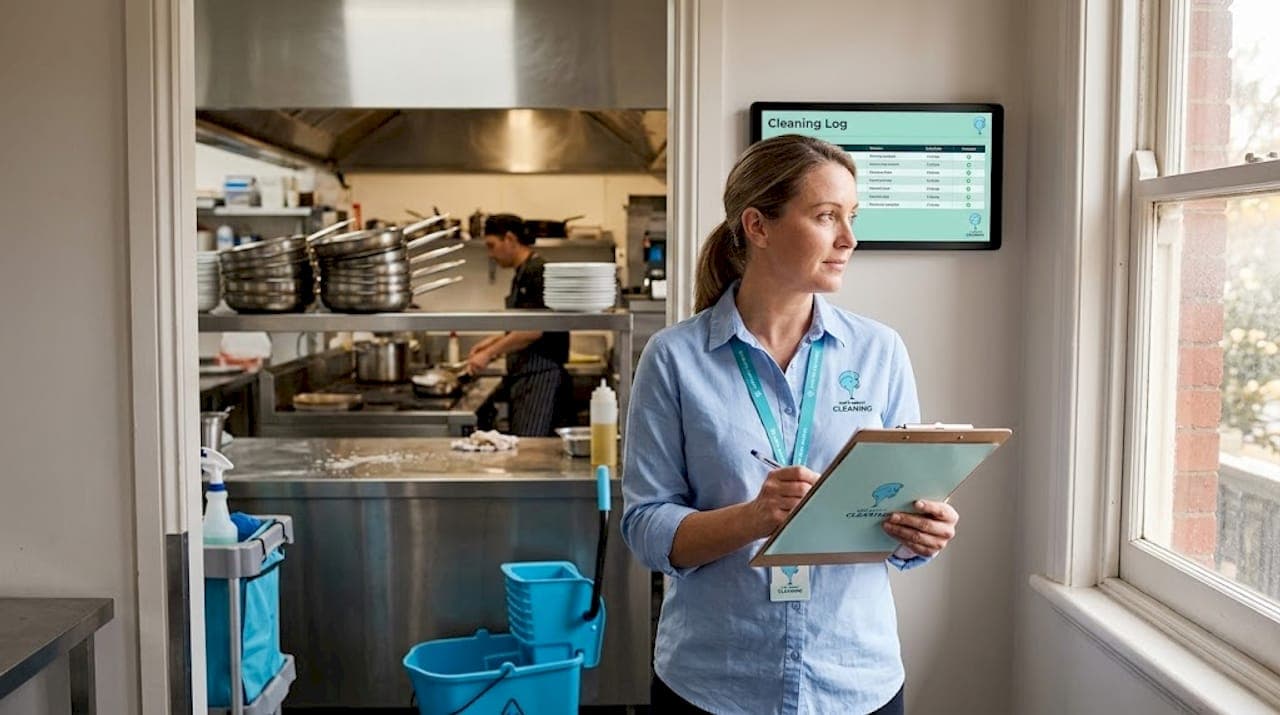
TL;DR:
- Cleaning compliance in Australia requires adherence to strict hygiene standards, documentation, and staff training.
- Non-compliance risks include closures, fines, reputational damage, and legal consequences across regulated sectors.
- Embedding a culture of compliance with regular audits and evolving standards ensures consistent, audit-ready facilities.
Facility managers across Australia face a reality that many overlook until it's too late: keeping your building clean and keeping it compliant are not the same thing. A spotless floor or gleaming bench doesn't automatically satisfy the strict codes that govern healthcare wards, school canteens, or hotel kitchens. Non-compliance can trigger shutdowns, financial penalties, and reputational damage that takes years to recover from. This guide breaks down exactly what cleaning compliance means, which Australian regulations apply to your sector, and the practical steps you need to embed compliance into your daily operations.
Table of Contents
- What is cleaning compliance and why does it matter?
- Key regulations shaping cleaning compliance in Australia
- Practical steps to achieve and document cleaning compliance
- Common compliance pitfalls and how to avoid them
- Why compliance is evolving: A facility manager's real challenge
- Take the stress out of cleaning compliance
- Frequently asked questions
Key Takeaways
| Point | Details |
|---|---|
| Compliance protects your people | Meeting cleaning standards prevents disease outbreaks and safeguards everyone in your facility. |
| Records are evidence | Accurate cleaning records are your first line of defence in any audit or investigation. |
| Mistakes are costly | Common compliance errors can trigger fines, reputational damage, or forced shutdowns. |
| Sector rules differ | Understand which regulations apply to your facility type to avoid accidental breaches. |
| Culture drives success | Facilities with engaged teams and robust compliance cultures outperform those relying on checklists alone. |
What is cleaning compliance and why does it matter?
Cleaning compliance refers to the systematic process of meeting all relevant hygiene, sanitation, and documentation standards required by law or industry codes. It goes well beyond wiping down surfaces. For facility managers in regulated sectors, compliance means following evidence-based procedures, training staff to execute them correctly, and maintaining records that prove the work was done.
The stakes are genuinely high. In healthcare, a failure to comply with infection control protocols can contribute directly to healthcare-associated infections, putting vulnerable patients at serious risk. In education, poor hygiene in canteens or bathrooms can trigger outbreaks of gastroenteritis that force school closures. In hospitality, a single failed food safety audit can result in a public health notice and media coverage that damages your venue's reputation overnight.
"Cleaning compliance is not a background administrative task. It is a core operational responsibility that protects people, preserves your licence to operate, and signals to regulators that your facility takes safety seriously."
Understanding hospitality cleaning practices is a strong starting point, but compliance spans every regulated sector. Here is what makes it non-negotiable across industries:
- Health and safety obligations: Australian work health and safety legislation requires employers to provide and maintain safe environments. Inadequate cleaning directly breaches this duty.
- Regulatory audit exposure: Facilities in food-related, healthcare, and education settings are subject to scheduled and unannounced inspections by local councils, state health departments, and food safety authorities.
- Legal and financial consequences: Non-compliance can lead to improvement notices, fines, temporary closures, or prosecution under relevant legislation.
- Reputational risk: In an era of online reviews and social media, a single inspection failure is publicly visible and quickly shared.
- Insurance implications: Some insurers will reduce or deny claims if non-compliance contributed to an incident, particularly in food service environments.
Under the FSANZ Food Standards Code standards 3.2.2 and 3.2.3, hospitality cleaning requires a two-step clean-sanitise process, HACCP-aligned kitchen procedures, maintenance of audit records, provision of functional handwashing facilities, and regular disinfection of high-touch surfaces. These are not optional recommendations. They are enforceable requirements. Understanding cleaning standards and safety across regulated settings is the foundation every facility manager needs before building any cleaning programme.
Key regulations shaping cleaning compliance in Australia
Australia's cleaning compliance landscape is shaped by a layered set of frameworks that vary by sector. Facility managers need to understand which regulations apply specifically to their environment, because applying a generic cleaning approach across a hospital, a childcare centre, and a commercial kitchen will leave dangerous gaps.
The two most prominent frameworks for hospitality and food-related facilities are the FSANZ Food Standards Code and HACCP (Hazard Analysis and Critical Control Points) principles. As required under the FSANZ and HACCP framework, facilities must follow a documented two-step clean-sanitise method, maintain comprehensive audit records, and enforce high-touch surface disinfection at specified intervals. These requirements apply to any food business operating in Australia, including hotel kitchens, school canteens, aged care kitchens, and hospital food preparation areas.
Here is a practical comparison of cleaning compliance requirements across the key sectors Australian facility managers oversee:
| Sector | Primary framework | Core cleaning requirement | Documentation required |
|---|---|---|---|
| Hospitality and food service | FSANZ 3.2.2, 3.2.3, HACCP | Two-step clean-sanitise, high-touch disinfection | Cleaning schedules, audit records, temperature logs |
| Healthcare | Infection Prevention and Control guidelines, AS/NZS standards | Terminal cleans, colour-coded equipment, PPE use | Cleaning verification forms, incident logs |
| Education (childcare, schools) | National Quality Standards, state health codes | Daily sanitation of shared surfaces, food prep hygiene | Daily logs, illness notification records |
| Commercial kitchens | FSANZ, local council regulations | Surface sanitisation, waste management, pest exclusion | HACCP plans, inspection reports |
Exploring kitchen cleaning standards in depth helps illustrate how detailed these requirements become in practice. A facility manager cannot simply instruct staff to "clean the kitchen." The procedure must specify product dilution rates, contact times, surface types, and the precise sequence of clean-first, sanitise-second.
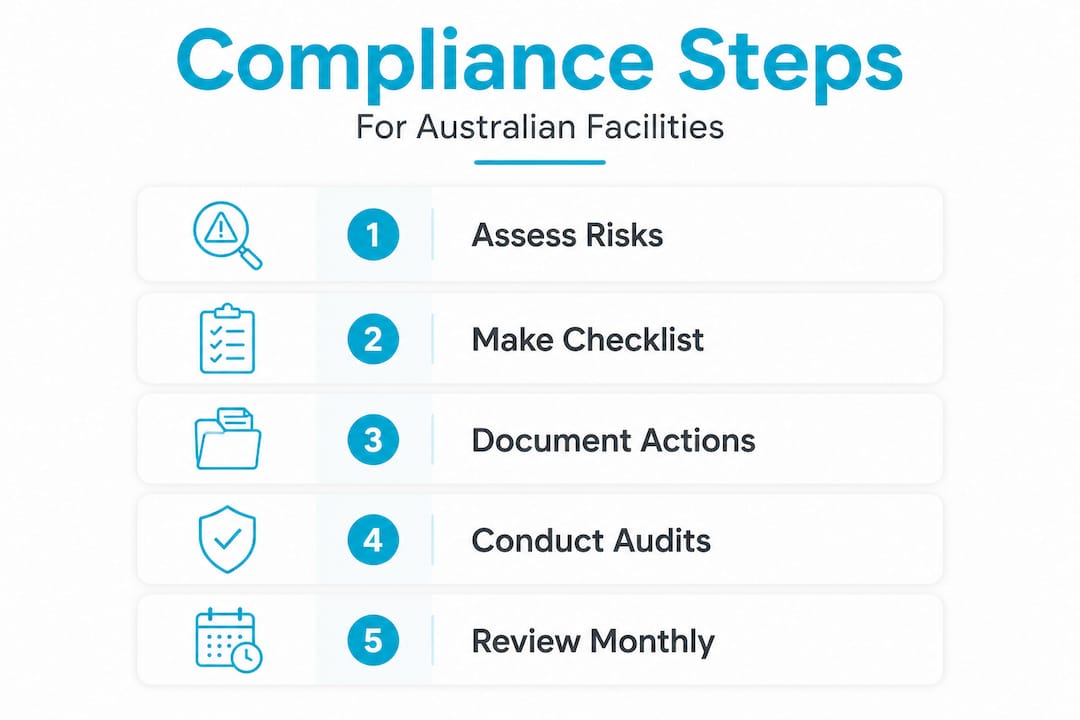
Here is a numbered breakdown of the essential compliance actions every Australian facility manager should have in place:
- Identify your applicable frameworks. List every regulatory body and code that governs your sector, including local council requirements.
- Map your high-risk zones. Kitchens, bathrooms, clinical areas, and shared contact surfaces are your critical control points.
- Select compliant products. Cleaning and sanitising agents must be fit-for-purpose and used at correct concentrations.
- Train all cleaning staff. Compliance depends on consistent execution. Every person involved needs formal, documented training.
- Establish your documentation system. Paper-based logs or digital platforms must capture who cleaned, what was cleaned, when, and which products were used.
- Schedule internal audits. Review your own compliance records regularly, not just when an external inspection is due.
- Update procedures when standards change. Regulations evolve. Your cleaning programme must reflect current requirements at all times.
Reviewing top cleaning standards for Australian compliance in 2026 provides a useful reference for keeping your procedures current across multiple sectors.
Practical steps to achieve and document cleaning compliance
Knowing the regulations is only part of the challenge. Turning that knowledge into consistent, auditable practice requires a structured operational approach. The facilities that perform best during unannounced inspections are not the ones that panic-clean before audits. They are the ones that have embedded compliance into every shift, every procedure, and every record.
Start by building a sector-specific compliance checklist tailored to your facility's actual layout, risk zones, and applicable codes. A generic cleaning checklist downloaded from the internet will not satisfy a HACCP auditor or an infection control review. Your checklist must name specific surfaces, areas, frequencies, products, and contact times relevant to your facility.
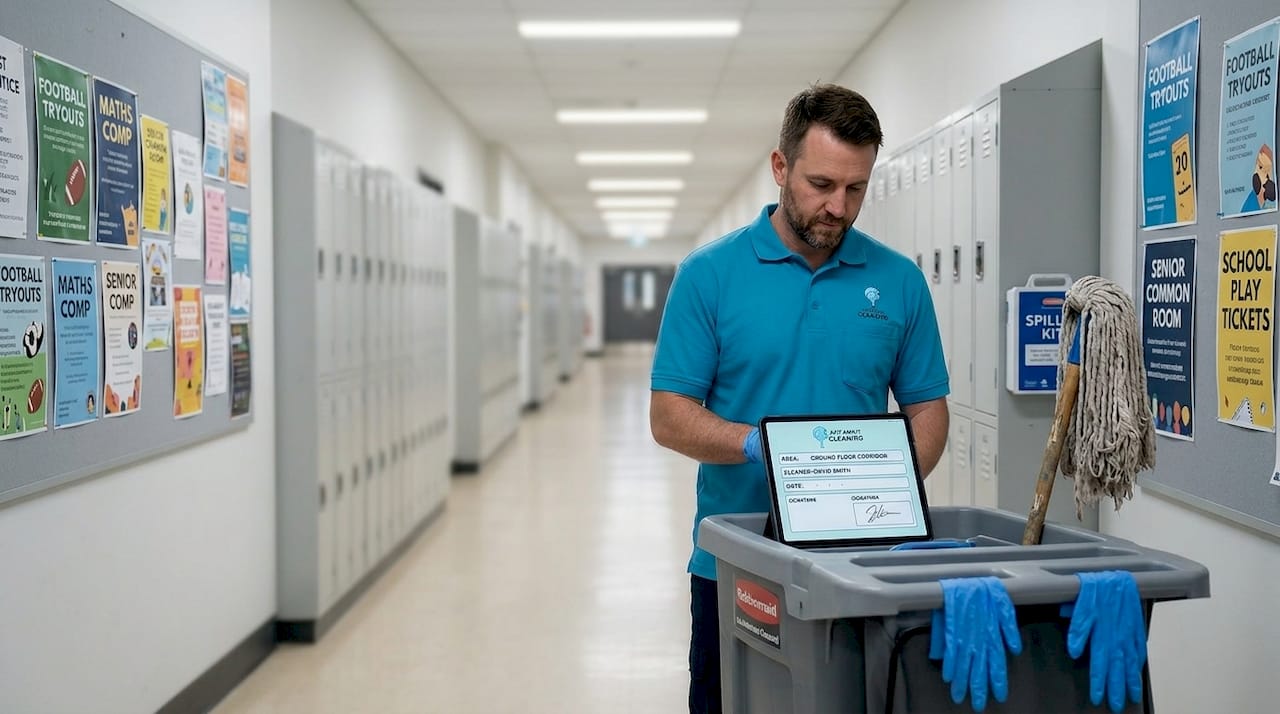
Documentation is where many facilities fall short. Audit-ready records and documented cleaning processes are mandatory under FSANZ and HACCP codes, and inspectors are trained to identify gaps. The following table shows how compliant facilities typically structure their documentation:
| Documentation type | What it must include | Review frequency |
|---|---|---|
| Daily cleaning log | Date, time, area cleaned, staff name, products used | Reviewed weekly by supervisor |
| HACCP plan | Critical control points, corrective actions, verification steps | Reviewed annually or after incidents |
| Staff training records | Training completed, date, trainer's name, sign-off | Updated with each new staff member |
| Audit trail | Internal audit dates, findings, corrective actions taken | Maintained for minimum of two years |
| Product usage log | Dilution rates, batch numbers, expiry dates | Checked monthly |
The numbered steps for embedding documentation into your daily operations are straightforward:
- Assign a responsible person per shift to complete and sign cleaning logs before leaving.
- Store records in a central, accessible location so supervisors can cross-check compliance daily.
- Conduct a weekly supervisor review of all cleaning logs to catch missed entries early.
- Perform a formal internal audit monthly using your sector's regulatory checklist as the benchmark.
- Retain all records for the required statutory period, which is typically two years for food businesses.
Understanding warehouse cleaning compliance and safety shows how documentation requirements extend well beyond kitchens and clinical areas into industrial and storage environments as well.
Pro Tip: Switching from paper-based logs to a digital compliance platform dramatically reduces the risk of missing entries and makes audit preparation far faster. Many platforms can send automated reminders to cleaning staff, flag incomplete records, and generate compliance reports in minutes.
Common compliance pitfalls and how to avoid them
Even well-intentioned facilities fall into compliance failures. Most of them are avoidable. The problem is usually not a lack of cleaning effort. It is a failure to apply the right method, use the right product, or keep the right records consistently. Knowing where facilities typically go wrong gives you a clear advantage before your next inspection.
Here are the most common compliance pitfalls and practical ways to prevent each one:
-
Ignoring high-touch surfaces. Door handles, light switches, lift buttons, tap fittings, and touchscreen kiosks are touched dozens or hundreds of times per day. Many facilities focus cleaning effort on floors and benches while these surfaces accumulate pathogens between cleans. Fix this by mapping every high-touch surface in your facility and including it explicitly in your cleaning schedule with specified frequencies.
-
Using one-step cleaning when two steps are required. Many staff members apply a combined clean-and-sanitise product and believe the job is done. Under FSANZ and HACCP requirements, missed sanitising steps are a key audit fail point. The correct process is to remove visible dirt first, then apply sanitiser and allow the required contact time before wiping.
-
Outdated cleaning procedures. Australian standards are updated regularly. A HACCP plan written in 2019 may not reflect current requirements. Facilities that never review and update their procedures are operating on assumptions that could fail under scrutiny. Set a calendar reminder to review all procedures annually, and after any significant change to operations or regulations.
-
Incomplete or unsigned records. An auditor reviewing a cleaning log that is missing dates, staff names, or signatures will treat that as a documentation failure regardless of how clean the facility looks. Train staff to understand that an uncompleted record is a compliance risk, not just a paperwork inconvenience.
-
Inadequate staff training. High staff turnover is a reality in hospitality and education. When new staff are not trained to the same compliance standard as experienced ones, gaps open up quickly. Every onboarding process must include documented compliance training specific to your facility's cleaning procedures.
-
No internal audit process. Facilities that only review compliance when an external inspection is scheduled are always reactive. By the time an auditor identifies a problem, the facility has been non-compliant for weeks or months. Internal self-audits reveal problems early, while they are still easy to fix.
Understanding routine cleaning importance reinforces why consistent daily practice, rather than occasional deep cleans, is the backbone of any compliant facility.
Pro Tip: Run a monthly self-audit using the same checklist your external auditor would use. Involve your cleaning staff in the process. When staff understand what auditors look for, they are far more likely to maintain the standard consistently between inspections.
Why compliance is evolving: A facility manager's real challenge
Here is something many compliance guides won't tell you directly: the facilities that consistently pass audits are not the ones with the most detailed checklists. They are the ones where compliance is treated as a genuine organisational value, not a box-ticking exercise. That distinction sounds philosophical, but it has measurable operational consequences.
In our experience working across healthcare, education, and hospitality environments, we have seen well-resourced facilities fail inspections because their cleaning systems lived entirely on paper and were disconnected from day-to-day operational culture. Conversely, we have seen lean teams in high-pressure environments maintain exemplary compliance records because their facility managers invested in staff understanding and genuine accountability.
The regulatory landscape is also shifting. Reviewing Australian compliance standards for 2026 makes clear that expectations around documentation, verification, and sustainability in cleaning practices are increasing, not stabilising. Auditors are trained to look for culture, not just records. They want to see that your staff understand why procedures exist, not just that they can execute them.
Proactive compliance oversight also delivers a business advantage that reactive checklists simply cannot. Facilities that monitor their own compliance continuously spot risk early, reduce incident rates, build stronger supplier and regulatory relationships, and spend far less time in crisis management. The initial investment in building a robust compliance culture pays back repeatedly over time.
The future of cleaning compliance in Australia will increasingly involve technology. Digital audit platforms, sensor-based monitoring of high-risk areas, and real-time documentation are no longer exclusive to large hospital networks. Facilities of all sizes can access these tools, and the ones that adopt them early will have a significant operational edge as inspection standards continue to rise.
Take the stress out of cleaning compliance
Maintaining cleaning compliance across a regulated Australian facility requires consistency, expertise, and the right operational support. For many facility managers, the challenge is not understanding the standards. It is having the time, the trained staff, and the documentation systems to meet them every single day.
Just About Cleaning Australia has spent over 15 years delivering compliant commercial cleaning solutions across healthcare, education, hospitality, and beyond. Our trained crews understand the specific requirements of your sector, follow documented procedures aligned with FSANZ, HACCP, and relevant Australian standards, and provide the audit-ready records your facility needs. Whether you manage a single site or a network of facilities, Just About Cleaning services can be tailored to your compliance requirements, your schedule, and your sector. Get in touch today for a sector-specific compliance consultation and take the uncertainty out of your next inspection.
Frequently asked questions
What are the main cleaning compliance codes in Australian hospitality?
FSANZ Food Standards Code 3.2.2 and 3.2.3 and HACCP are the primary frameworks, requiring a two-step clean-sanitise process, audit records, and regular high-touch surface disinfection across all hospitality and food service environments.
Can poor cleaning records affect my facility's audit outcomes?
Yes. Incomplete audit records can result in inspection failures, improvement notices, or fines regardless of how physically clean your facility appears at the time of the audit.
What is the two-step clean-sanitise method?
The two-step method requires you to first physically remove visible dirt and debris, then apply an approved sanitiser and allow the correct contact time. This process is mandated under FSANZ and HACCP requirements for all food-handling and hospitality environments.
Are high-touch surfaces mandatory to clean for compliance?
Yes. Regular cleaning and disinfection of high-touch surfaces, including door handles, taps, and shared equipment, are explicit audit requirements under Australian food and hygiene codes and cannot be omitted from any compliant cleaning schedule.